

It’s been a while since I wrote the Beyond AB segment (my apologies) and a comment from someone in Ontario, who hails from the U.K., prompted me to think about the state of federal politics from the perspective I know best; Alberta. The way that I think about politics generally, however, might be full circle.
Before I discovered politics, I had a job at a motel working two overnights during the week and late shifts (3PM-11PM) on the weekend. I had nothing to do during those shifts as it was rare that the place wasn’t already full and time went by so incredibly slowly. Despite the fact that the internet existed, I didn’t think to bring my laptop with me. Instead, I bought a library card and searched for something that would possibly entertain me for 32 hours a week.
That “something” turned out to be historically accurate novels about families that fought for the Throne of England.
I devoured them— and not just because I had four children between the ages of 11 and three at home who could never offer me that kind of uninterrupted time to simply read— they were fascinating. In retrospect, they primed me well for falling so hard for the world of politics in this century. It was not much of a leap to consider political parties as the modern version of those overzealous families and their quest for power; they’re just less murder-y about it today.
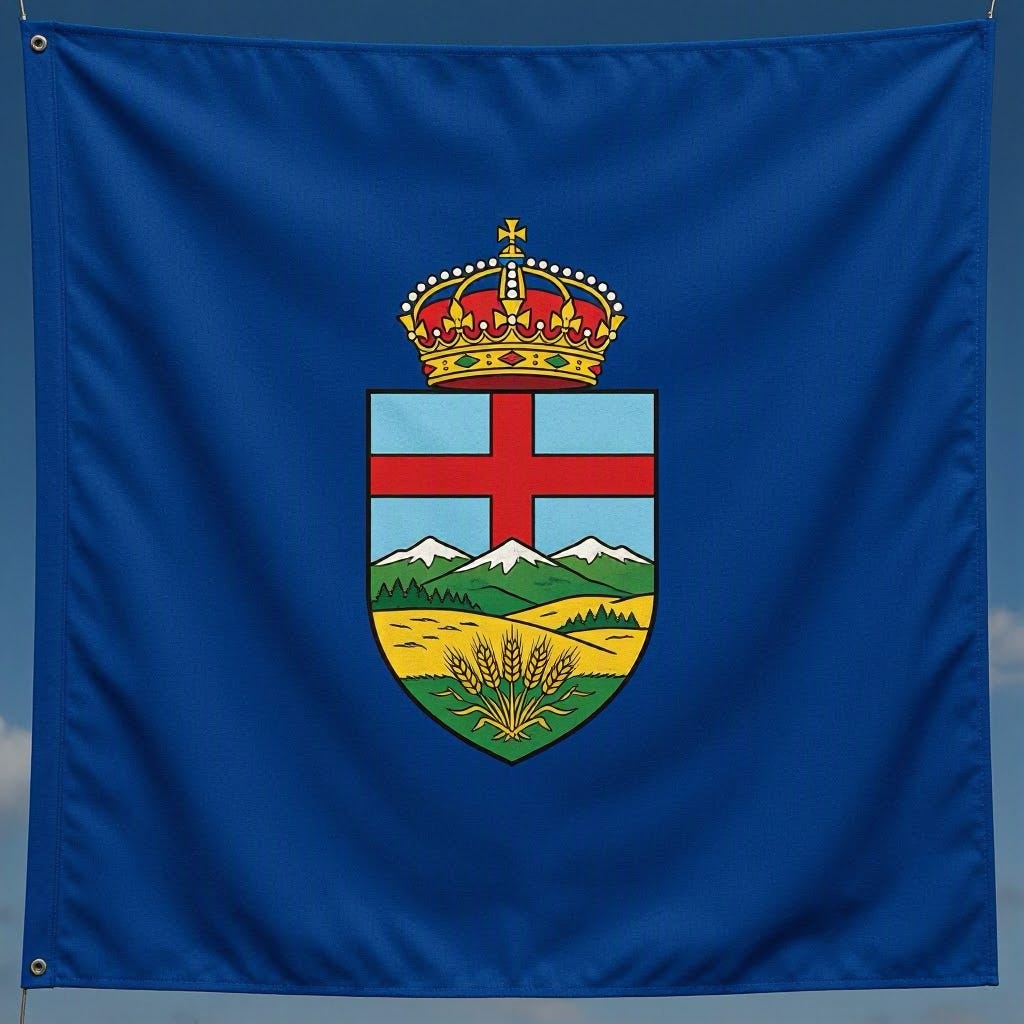
They even still use their own “crests”, and multiple “families” align (they even call themselves provincial or federal “cousins”), and the motivations, scheming, alliances, treachery, failures and victories is the same as it ever was.
That is the lens through which I view politics today. There is one goal, made slightly more difficult by “fixed election dates” but still not impossible: to take the place of the King (or Queen, as the case may be).
Where I once thought of the political party as the only contender, I realized that there are some families within the broader alliance who are still making their play; that would be the provincial entities, which brings us closer to the comment that inspired this post.
A different world
Every year, during the first week of July, Alberta is transformed from a forward-thinking, highly educated bastion of ingenuity into an homage to the days when survival depended on a blessing from mother nature or the generosity of one’s neighbours. Many of us have an outfit or three that never see the light of day outside of that single week. We have a hat that still isn’t worn in despite the fact that it’s more than a decade old and a pair of boots that have never touched the belly of a horse, nor had their soles sink into the earth. Instead, they’ve only felt the unforgiving strength of concrete, asphalt, and tile, either hidden under a desk or shown off at a concert or on a dance floor during Stampede week.
Within that “culture” lies or stems an attitude that is closer to the days of auld than life today. Perhaps you’ve seen it making the rounds lately on social media in the form of AI recreations in support of the separatist “cause”. It has its roots in this fight for power rather than survival; a relic of a history that promised self-determination but imposed a tradition of structure, order, rules, and law that is purposely misinterpreted as a continuation of a feudal state rather than accepted as building blocks of a shared society.
That remnant of history is added onto cherry-picked moments from our past and layered onto our present and future. For a small few, it results in separatist ambitions. For everyone else, it creates a “conservative disposition”; no matter where they sit on the political spectrum. Albertans are anchored by this history even if they manage to let go of some of the weight to become more progressive, or dare I say “liberal”.
This is the reason why everyone from Alberta, whether they are NDP or the current Prime Minister of Canada, seem more conservative; we are all anchored by “Joe”.
“Joe” is both a caricature and a character brought to light— not life— by research conducted by Common Ground Politics, led by Dr. Jared Wesley at the University of Alberta. “Joe” is both a perception and a real person. Most people in Alberta know a “Joe”; everyone in rural Alberta has met one. The most damning evidence of our collective brainwashing is that even newcomers to Canada can draw a picture of “Joe”.
In Alberta, our governments make policy with “Joe” in mind (and that’s where the Alberta NDP missed the mark but that’s for another post). I heard the story once of a person running into then-UCP Health Minister Tyler Shandro at a cafe in downtown Calgary during the great mask debate of COVID times. They purportedly asked the Health Minister why his government was getting rid of mandates when we obviously still had a problem with virus spread. Mr. Shandro responded, “how do we tell the guy in Cold Lake that he has to wear a mask?”
That guy the Health Minister was referring to is “Joe”.
“Joe” is the reason the Reform Party couldn’t get elected east of Manitoba. “Joe’s” influence is the reason Stephen Harper started muzzling scientists and cancelled the census. “Joe” started the convoy to Ottawa. Sorry.
I have to add that “Joe” isn’t necessarily a bad guy. He can be the absolute worst— as I said, he’s both a caricature and a character, a perception and a real person— but he doesn’t have to be. Most of the time, “Joe” is just a person who thinks much, much, more locally. He’s not worried about the plight of Calgarians, or Canadians, let alone the world, because he’s far more concerned about his immediate surroundings. He understands household budgets and kitchen table politics. He’s concerned about what affects him and he’s used to that being reflected back to him by his government.
Unfortunately, the biggest influences on “Joe” speak his language and those people are increasingly bad-faith actors who tell him that Ottawa is responsible for all his problems. The reflection from “Joe” to our current conservative leadership today is a hall of funhouse mirrors reflecting a distorted version of himself back to him.
And the reason Pierre Poilievre is so incredibly unpopular is because his entire political philosophy is based around that long storied version of what “Joe” wants.
Flying the Alberta crest
I think of the PC’s and Liberals much the same as families from centuries past, like Tudor and Windsor, but there were other families, like Lancaster and York, who also vied to be the lead family in line for the Throne. This is where Alberta and prairie conservatives, come in. If you’re one of those conservatives who no longer recognize the Conservative Party of Canada as remotely like the PC’s they once were, it’s because Alberta and prairie conservatives took it over.
On one hand, I feel as if I’m giving it way too much importance; on the other, when conservative staffers lost federally or elected officials tired of being small fish in a big pond, they were offered jobs in Alberta (other than that time the NDP was in power— or when there was a possibility they could remain there—the resentment runs very deep).
Stephen Harper was from the Christian Heritage/Canadian Alliance wing who welcomed Reformers like Pierre Poilievre, Jenni Byrne, Jason Kenney, etc.. They wanted “real change” and paid lip service to the Progressive Conservative wing of the party in the same way the former Progressive Conservatives did to them before.
To me, it’s often been apparent when Alberta conservatives are running communications for the federal party because that’s when they seem to lose the rest of the country. Andrew Scheer increased the conservative vote in the west and rural where they didn’t have more seats to gain instead of in more populous areas east of Manitoba.
Progressive Conservatives had, based on their time leading the federal government, a better feel for the pulse of a majority of Canadians. When Pierre Poilievre seems repellant, it’s because he’s coming from a place where a minority of Albertans are; perpetually victimized by overly exaggerated or entirely fabricated wrongs. I know this because I’m very, very close to it out here in rural Alberta under a Danielle Smith government.
In a way, it was very much what the convoy represented; at its worst, people gathering their torches and pitchforks against the federal government for things the provincial governments were doing— vaccine and mask mandates— or another government entirely— like the U.S. Administration prolonging the cross-border travel ban for those who refused to get vaccinated. At its best, issues that a majority of Canadians were also sympathetic to but whose circle of consideration was simply bigger than a personal inconvenience.
It’s also why Mr. Poilievre was at home with, and then went on a national tour to energize the people with those issues and those sentiments; it all comes back to trying to rally for the less popular vision of the family who wants to gain power.
In this case, that’s Alberta and the distorted reflection of a guy named “Joe”.
“Joe” is next in line
Prime Minister Mark Carney is, in my opinion, an accurate reflection of liberalism in Alberta. It’s “Liberal”, but with a hefty dose of conservatism. The Leader of the Official Opposition is a distorted reflection of “Joe’s” Conservatism. Seriously though, if Heather McPherson would have become the NDP leader, I think it would have been too much. I love my province and my history but that would have been like a Twilight Zone episode in the making. No offence to Ms. McPherson.
While I wouldn’t necessarily consider Alberta the “centre of the universe”, here we now stand, politically speaking.
Like the family history of those who fought for the Crown of England, Alberta’s history is entirely relevant to politics in Canada today. That’s not to say there are no other influences; the Prime Minister is obviously influenced greatly by those in Europe, and the Leader of the Official Opposition is obviously heavily influenced by those in the U.S.. The difference is stark: the E.U. is collectivist and the U.S. is individualistic. The E.U. works on policy that benefits people and the U.S. works on policy that benefits corporations (if they’re based in the U.S.).
Right now, Alberta is central to Canadian politics; in the Prime Minister’s office and the LOO’s. Pun intended.
Thanks to everyone who reads, shares, and becomes a free subscriber. Please consider becoming a paid subscriber to support my work; to those who have, your support is greatly appreciated!
I always bring it back to this.
I believe in us. The alt right believe in me and mine.
Another great essay Deidre
This is a must read for all Albertans. Thanks.