

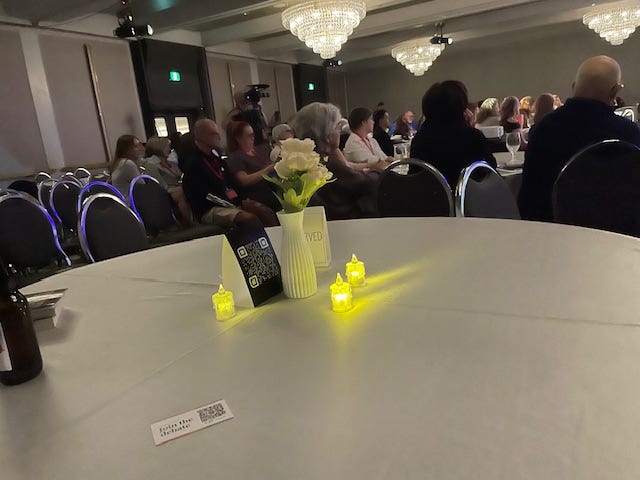
I signed up for an event I’d never heard of before last month called “We Unify.” That sounds nice, doesn’t it? There was a ridiculously long list of speakers, many of whom were billed as “Conservative influencers” and I didn’t know most of them.
Apparently it wasn’t supposed to be a separatist event. Yet…
I’ll admit I did not do much research on it. For some reason, I thought it might be related to regular old politics. Alas; I was mistaken.
After being thrown for a loop by this unexpected twist— and annoying one person (on purpose; sorry Josh, it had to go somewhere), almost giving some guy from B.C. who consumes way too much FOX “news” an aneurysm, and telling a volunteer/speaker off with the help of a random gentleman from Ontario (who was there for a wedding) I happened to be sitting with at the time— I gave up any pretense of “blending in.”
Not that I was probably making much headway since I chose to wear my little Canada flag lapel pin.
I did clean house on free swag, however. You know it has to be top of the line when they’re giving away piles of DVD’s and books for free. For now, they will just have to remain in the little blue bag of future sadness while I deal with this.
The stories we tell
I took a class on the sociology of narrative when I was in university. In one of my proudest moments as a student, I absolutely scandalized the professor by taking on the narrative of “Reefer Madness.” My argument was somewhere along the lines of how that entire campaign (which was also a way to target Mexican immigrants) probably did the exact opposite of what it was meant to because it dialed up the fear-factor to 11 and didn’t deliver. To me, if you’re going to try and claim that weed will make the kids go mad, and then they try it and don’t come anywhere close to having that response, they won’t trust another word you say.
We all have a narrative; for our lives, our experiences, and our relationships. Some of those might be very true but some of them might be what we’d rather tell ourselves and others. It’s entirely human (and psychological).
Sometimes, though, the narrative is a tool.
Someone once told me that one of the reasons Jehovah’s Witnesses are sent out into the community is because they will typically encounter people who don’t embrace them or their faith. They said it’s a tool to reinforce the safety of the congregation and the church. The narrative is that they can count on the warmth and acceptance of those who share their faith.
Separatists have adopted the latter.
They tell a lot of stories about finding nothing but hate and friction in the outside world. Everyone in the room is “open” because they’re “willing to listen” or “able to engage the conversation with civility,” while everyone who disagrees with them screams “vile things” and wishes them dead.
For the most part, I think the audience was receptive to it and were also told to go out and have these conversations with their family and neighbours who had a “Forever Canadian” sign.
Of course; because what might happen is they get shut down or frozen out and come running back to the welcoming arms of the people who expected them to be met with hostility in the first place. See above.
Eva Chipiuk, a Convoy lawyer and separatist sympathizer in her own right, told a story about how Nellie McClung didn’t take “no” (you’re not worthy of “person” status) for an answer. Somehow, this was meant to be equated with taking away the rights of people who work here temporarily to access healthcare, but pay taxes, and stripping some of us of the right to remain in Canada because someone else doesn’t want to.
I’d been thinking about an actual equivalency and I was able to use it today. In response to a question about why I would vote to stay, I said that my ancestors chose Canada and I wanted to come back to Canada when I was living outside the country. I added that the entire argument is silly; it’s like me saying I don’t want to live in Saskatchewan but also that no one else should be able to, either.
Of course that makes no sense.
I bet there were Quebeckers making the same argument right up until their referendum as well. Not the Saskatchewan part, probably, but it would work equally well. Sorry, Saskatchewan; fix your roads. There’s not an immediate “oh, I’m obviously in B.C. now” feeling like there is when we cross into Saskatchewan. SHOULDERS ARE GOOD.
I digress.
There were other stories as well, like “separation is just an administrative change— no biggie!” Or “we need to be able to elect the people who will make decisions.” I’m sitting there thinking “I voted Liberal. I did— at least help— elect the people who will make decisions.”
I didn’t have the chance to ask anyone today, but I did ask at the last event, “how small are you willing to make your world until everyone agrees with you?” Like, sure, provincial separation today but what about tomorrow? Split the province in half? Put up some Berlin-esque walls in small towns and cities? How small does the space need to be to fit you?
Erm, know your audience
I was obviously the fish out of water here, but when the Brit who is part of the corporation suing the U.S. govt over tariffs (and also briefed Danielle Smith before she went to Mar-a-Lago), and the Aussie/Papua New Guinean who “drove all night from Colorado” and the previously disqualified UCP candidate (Nadine Wellwood) took the stage, it was really getting a bit much.
However, my interest was piqued when they (all of them) stepped in it; with data centres.
Data centres are not popular in rural Alberta. Something about them needing excess fresh water has, for some reason that seems to be difficult for some people to understand, set the farmers and ranchers off.
To the moderator’s credit, when people in the audience responded “no” multiple times, she decided to go back to it.
They all doubled-down.
Then the one guy is like “and they should get more government subsidies!” As if he thought he was on a roll.
The gentleman who I’d shared a table with since arriving hours ago finally decided to ask if I was the official note-taker for the event because I’d been typing all day. I pretty much do it to keep from banging my head against the table, but, anyway, I informed him I was keeping notes for myself.
I hadn’t intended to start a conversation as he’d whooped more than once to things I’d not found either whoop-worthy nor passingly interesting. He told me that he was an American who has been living in Canada for 25 years. I had more questions, but then the next speakers were ready to go.
I will find him tomorrow and hope that the single beer he had purchased isn’t the reason he finally decided to chat.
Because, yes, there’s another seven hours of something tomorrow, too.
Some conversations might be worth having
For the “think about this a bit” side, Ben Trudeau made another appearance, and I was introduced to Bill Jones and Michael Binnion. They all urged Albertans to take control of things they could before they tried to take the leap towards separatism or true independence.
Mr. Jones described it as being offered an artist’s rendering of a new house but when you get there, it’s just an empty lot full of stumps and mud. Sure, it looks nice in the drawing— the blueprints are exciting— but the reality is that it has to be built and they haven’t given us a price point yet, or a timeline.
Mr. Trudeau again stressed that Alberta should be doing all the things it can do to demonstrate that it could govern itself.
Mr. Binnion said that Ottawa responds to those that demonstrate they can govern themselves.
These are people talking about our future, not our past. This is a conversation I am completely willing to engage in— even if the goals are different. This is a debate worth having because we can do something about it.
I’ve followed and forgotten (figuratively) the painful past that few people today have actually lived. It’s gone. What else do you have to offer?
And then there's the problem of all those things that are equally part of “Alberta culture” but entirely incongruent with separation. We want low taxes. We don’t actually want to pay more to do all of the things the federal government currently provides us with our tax dollars.
That’s why it fizzled out under Ralph Klein; it would have meant raising taxes to recreate the very services we already get from the federal government.
In case you’ve never met more than a few Albertans, they don’t want to pay more for things they already get. It’s a thing.
And from there… I still can’t see a there, there.
Of all the speakers, Mr. Trudeau, Mr. Jones and Mr. Binnion actually spoke about our province’s future, but also about “strength.” The rest of the speakers were still down in the dumps over things that happened 116 years ago, or 70 years ago.
I’m sorry that happened and all, but could you join us in today-land by chance?
We cannot change the past, especially if we’re still living in it.
I’ll be back tomorrow evening with… more.
If you’ve been reading Women of ABpoli for a while and find my analysis useful, a paid subscription supports the time it takes to attend these events, follow the stories and do this work—and gives you access to my deeper analysis.