

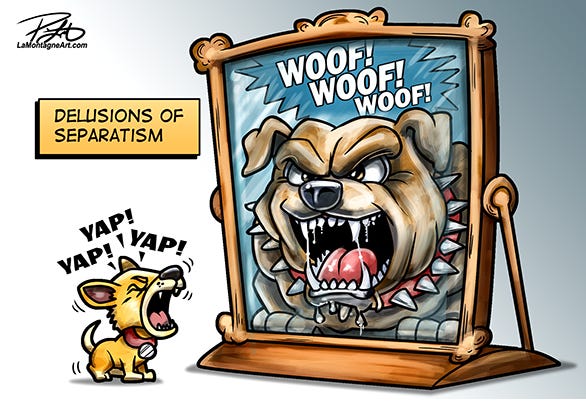
In late 2024, when Justin Trudeau was still Prime Minister and Donald Trump first promised to use economic pressure to turn Canada into the 51st state, it seemed likely that there would be a resurgence of the separatist movement in Alberta. As those who know often add, it’s never really gone away, but that could also be because it’s the same people around the margins or on the stage. Even through a Reform Party breakthrough, and the folding of the Progressive Conservative Party of Canada into Reform to create the Conservative Party of Canada, and then through the Stephen Harper years, it always existed, just waiting for its moment to return to relevance.
The difference is that it simply didn’t get as much attention from the people now being referred to as “separatist curious”, and because separatists couldn’t break out of their bubble of the truly initiated, no one else was willing to pay them much attention.
That changed after United Conservative Party leader and Alberta Premier Danielle Smith gave them a helping hand, and another, and another.
The most recent iteration was David Parker’s Centurion Project, which dragged itself up by the coattails of the United Conservative Party and the Alberta Prosperity Project (APP). Mr. Parker is currently refusing to cooperate with an Elections Alberta investigation into how he came into possession of the List of Electors that was given to the pro-U.S. annexation Republican Party of Alberta. RCMP are also investigating and perhaps the upstart Centurion Project is not long for the Alberta politics sphere.
The APP was founded by Dr. Dennis Modry in 2021. Dr. Modry was previously a policy director for the Wildrose Independence Party of Alberta, which was created from a merger between Derek Fildebrandt’s Freedom Conservative Party and WEXIT Alberta.
Before the Alberta Prosperity Project, which commands influence over United Conservative Party leader Danielle Smith, there was WEXIT, which followed Reform, which followed the Western Canadian Concept.
Before the 2019 election, WEXIT was just a Facebook group with a few thousand members. On the evening of the federal election, I received an invite to join and watched over the following couple of days as it grew to over 200,000 members.
The administrator of the group, Peter Downing, was not new to separatist circles but what happened after the Liberals won that night was social media connecting tens of thousands of supporters. I’m not entirely sure how “they” wrestled it away from Mr. Downing, but my theory is that the federal conservatives’ survival instincts kicked in when he and cofounder Pat King (yep, that guy) registered the party with Elections Canada in 2020.
By this time, Jason Kenney’s United Conservative Party had retaken their rightful place as government of Alberta and people still angry about non-conservative governments existing were only too happy to redirect their efforts to another outlet. There was just one problem; the Conservative Party of Canada had already seen how this western grievance party plays out and they weren’t about to stand aside and let someone else rise up.
The Reform Party under Preston Manning’s leadership had initially run on the slogan “The West wants in”. In 1997, they even managed to form Official Opposition. Only two elections in, the party decided that it needed a rebrand and renamed itself the Canadian Alliance. They remained Official Opposition under Stockwell Day but it was obvious that the Progressive Conservatives were standing in the way of the party’s ability to form government. After Stephen Harper became leader, he merged the party with the progressive conservatives and created the Conservative Party of Canada. They remained Official Opposition for another election and formed a minority government in 2006 and 2008, finally managing a majority in 2011. When the CPC lost to the Liberals under Justin Trudeau in 2015, while Alberta was under an NDP government for the first time ever, it was a perfect storm for a western-alienation-focused resurgence… but the federal conservatives weren’t just going to start handing over their seats.
What happened next was a little too ‘on the nose’.
Former CPC MP Jay Hill became interim leader after Mr. Downing resigned and then changed its name to the Maverick Party. Mr. Hill said the party was focused on building grassroots support; in CPC-heavy territory on the prairies. There wasn’t much bluster, nor much organizing because after amassing those 200,000 supporters on Facebook, Mr. Hill only managed to run 29 candidates in the 2021 election. The party was deregistered in 2025 after failing to file financial statements.
It’s hard to look at the history and not think the federal conservatives had a hand in dousing that flame for their own political survival. Shortly after the 2021 loss, Pierre Poilievre was able to oust Erin O’Toole and capitalize on national grievances with a convoy-inspired tour across the country. People were extremely angry at Justin Trudeau for provincial health and vaccine mandates, as well as the U.S. decision to require up to date vaccinations for travelers. Mr. Poilievre was there to fill their boots with easy to read slogans and word salad that blurred the line between federal and provincial jurisdiction.
Mr. Poilievre sucked up all the oxygen on that topic. Across the prairies especially, he became the star of the anti-Trudeau show.
Meanwhile, in Alberta, separatist and freedom-minded conservatives alike banded together to rake Jason Kenney over the coals for his role in public health decisions. In another twist of irony, had Mr. Kenney left those decisions to the Chief Medical Officer of Health, as other premiers did, he might have avoided the backlash.
When Jason Kenney surprised everyone with his resignation after barely passing his leadership review, he gave the separatists the win they hadn’t earned— and they were ready to take advantage.
The UCP takeover
Alberta separatists and freedom-minded others had already encouraged many of their own supporters to sign up for United Conservative memberships, but in the race to replace Jason Kenney, there were still people who preferred a solid conservative leader. Then-Finance Minister Travis Toews was literally the last man standing before Danielle Smith was announced the winner of the race, having managed 53 per cent of the vote.
I can’t say who Ms. Smith was touring with during her leadership bid, but she was ready to pander to the separatist curious with her Sovereign Alberta within a United Canada Act, thanks to her number two, Rob Anderson and his Free Alberta Strategy.
The first discussion of the Strategy was hosted by Mr. Anderson himself, who later became Ms. Smith’s Director of Staff and then Chief of Staff after Marshall Smith made a quick exit in October of 2024.
Later in the leadership race, Danielle Smith, Todd Loewen, and Brian Jean participated in a debate hosted by the Alberta Prosperity Project.
Rebecca Schultz, Leela Aheer, Rajan Sawhney, and Travis Toews refused to participate.
David Parker at the time boasted more than just a supporter relationship with the new leader; she had been a guest at his wedding. Their relationship, whatever it was, hit a rough patch after Mr. Parker made disparaging statements about Pierre Poilievre’s wife Ana on social media.
Mr. Parker attended the UCP’s 2023 convention in hopes of discouraging members of giving the Premier their support by handing out pamphlets with anti-immigrant and anti-Islam messaging. She received 92 per cent support. However, he was (and likely still is) trying to move support away from the Premier, who may be subject to a leadership review this year.
Both Mr. Parker and Jeffrey Rath, who is affiliated with the Alberta Prosperity Project, are United Conservative Party members— apparently in good standing— still, even though being a publicly declared separatist would put someone in direct violation of the founding principles of the party. Thomas Lukaszuk was refused a membership to vote in Ms. Smith’s last leadership review because he had publicly supported the “lend your vote” campaign aimed at progressive conservatives to support the NDP instead of the Danielle Smith-led UCP.
They’re private clubs and they can offer or revoke memberships to anyone they like. Apparently, they like separatists, and they don’t like progressive conservatives who don’t support their current leader. Not supporting the past leader was fine.
I saw someone remark recently that they felt the separatists wouldn’t be talking about separation now if the CPC had formed government in 2025. I disagreed. Alberta separatists have always been talking; what they wouldn’t have if the CPC had formed government is anyone willing to platform them because there wouldn’t be anyone outside of their bubble willing to listen to them.
Despite all of the evidence to the contrary, Danielle Smith still wants to be seen as someone who is “fighting for” a united Canada. In the end, however, she’s only got one vote in the party, too. As David Parker and Jeffrey Rath continue to encourage like-minded Albertans to join the UCP, it’s entirely possible she will not last until the election if she can’t deliver what they’ve demanded.
Partisan lines
The other, other reason I will die on the hill that partisanship is damaging, potentially dangerous, and mostly foolish: separatist sentiment in Alberta ebbs and flows almost entirely along partisan lines. Specifically, its lure is entirely dependent on which party is in government.
Separatist sentiment in the province got a real boost a decade ago from having both a non-conservative government provincially and federally at exactly the same time (and that hadn’t happened in almost a century).
For this, I also lay some blame at the feet of conservative leaders and their flocks; Albertans have accepted the oft-sung political narrative that “Ottawa” is out to get us— if there’s a Liberal Prime Minister in residence. It’s why Alberta needed a “firewall” and someone to “fight Ottawa”.
I still say that if Stephen Harper hadn’t been in Ottawa for a decade, Jim Prentice’s Progressive Conservatives might not have lost the 2015 election. Unfortunately, the Premier was unable to blame the federal government for the recession we were speeding towards. Doubly unfortunate is that if Mr. Prentice had not called the election a year early, he could have. It wouldn’t have mattered if the Liberals had only been in power for six months, they still would have been in power and that sleight of hand works like a charm here.
It’s us against them.
Alberta vs Ottawa.
Conservatives vs Liberals.
As Jason Kenney has found, it’s hard to pivot; even for someone who loves this country.
Listening to the Hon. Jason Kenney and Calgary-Confederation MP Corey Hogan discuss the case for a united Canada on Monday, I was struck by how measured Mr. Kenney was, even though he had to work at it. As it happens, Mr. Hogan was a Deputy Minister in Jason Kenney’s UCP government as well, and the two had a different relationship prior to showing up on stage together.
Mr. Kenney noted that many of those in the separatist movement today are the same people who have been part of the right wing of Conservative politics since his days in the Reform Party.
And it’s just one more reason I have a grudge against conservative politicians who have used a Liberal government in Ottawa as a wedge that benefited them so greatly in their electoral endeavours.
The partisan divide on Alberta separatism is just as stark as it always has been; with more than half of UCP voters in support but only around three per cent support from those who vote for other parties. At least, that’s what the makeup is via polling, which is not necessarily an accurate picture of who is buying memberships, or already has, in the party.
Both Mr. Hogan and Mr. Kenney brought up the fact that separatism in Alberta is nothing like separatism in Quebec. First, in Alberta support breaks along partisan lines and in Quebec it does not. Second, a separatist party can get elected in Quebec, and they also have a plan; something Alberta’s motley crew does not.
Although the former has offered to help out the latter, so that should set us on a similar path to bragging rights without all that pesky investment or head offices cluttering up downtown Calgary, I’m sure.
I’m not a fan of partisan politics to begin with, but when it’s used as a trojan horse to bring in economically damaging, divisive policies, it’s even more repulsive than usual.
Yes, I’ll die on that hill because to my way of thinking, there’s no excuse for putting partisan interests ahead of people, province, or country.
Thanks to everyone who reads, shares, and becomes a free subscriber. Please consider becoming a paid subscriber to support my work; to those who have, your support is greatly appreciated!
As an Albertan in Quebec, I support this message. The QC/PQ effort is just a way for them to strengthen thier own (more justifiable) hand while joking that the UCP thinks they are equals to a real soveriegnist movement. The other key difference (besides the non-partisanship pointed out) is that separatists in Quebec are willing to pay higher taxes in return for more responsibility and independence. Albertan separatists would never agree to fund thier own "plan" and of course have asked for foreign loans before they have even a shred of a mandate or popular support.
I am fascinated that Jason Kenney has crafted a very partisan argument against the separatists, amounting to
1. They will fail, then
2. That will split the right in Alberta and elsewhere
3. The NDP will win here and
4. The federal Liberals will win seats in Alberta and be the national government for a generation.
Apart from me thinking that sounded like a great outcome, I also found it fascinating that he would actually suggest there's partisan advantage to be gained from a national crisis. I guess I shouldn't expect less (or more, as it were) from the smarmy <word for an illegitimate son>.
Oh well. At least he's in the fight on the good side. To borrow from the great Lin-Manuel Miranda:
I have never agreed with Kenney once
We have fought on like seventy-five different fronts
But when all is said and all is done
Kenney has beliefs. Smith has none.