

Much to-do has been made about “balance” not just recently but generally. In reporting, it is considered necessary to include “both sides” of a topic or issue that is currently being “debated”. I don’t mind this requirement generally; many ideas and solutions are, in fact, debatable, and I think it’s important to consider reasonable arguments about them. I also think it’s important to understand that while the “MACK truck” responses exist, they’re not worth including (most of the time).
In 2021, Kathleen Smith and I had a conversation with Alberta Today’s Catherine Grikowsky (formerly of other print newsrooms), and Sheila Pratt, who was the former editor of the Edmonton Journal (and other print newsrooms) about this idea of balance in reporting. As an example, Sheila offered that while it’s useful, and arguably necessary, with debatable things like policy options, she felt journalism generally had been detrimental to other areas, like science. Her example was climate science specifically, where equal weight was afforded to less than 3 per cent of “skeptics” against over 97 per cent consensus, in a field that uses expert consensus based on empirical study, research and testing — not “personal opinion”.
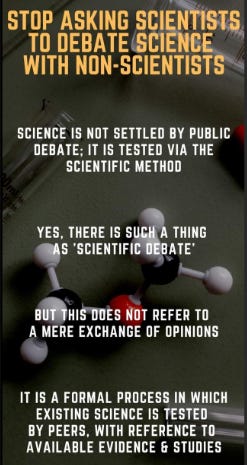
Think also of the much-publicized claim that universities are ground zero for liberal indoctrination. In support of such claims, many point to the fact that they (typically non-academics) disagree with academics. I recall a period of time when those people were demanding where their experts were; a bold assessment, if you think about it. Believing one is right, and finding no expert to agree with them, might also suggest that the logical conclusion is one is in fact wrong.
My theory about this claim is that the dissenters have confused who is the chicken and egg in this scenario. If they disagree with a policy because of the party who proposed it, and upon further investigation, see that experts have the same opinion, they’ve cast the allegation that the expert is then “liberal”, when in fact it was the experts who held the opinion and the “liberal” who adopted it. This was evident when former Premier Jason Kenney dared to adopt advice from his Chief Medical Officer of Health during the pandemic. The leader of the franken Wildrose-Christian Heritage party (aka the United Conservative Party) became widely denounced by many in his party as “a liberal” because his policy was considered “favoured” by those who were also liberal.
Having been the target of such inconsistent logic, however, doesn’t seem to have fazed him as he had quite the meltdown on social media over an article he read that didn’t reflect his personal opinion and therefore must be “biased”.
It also somehow reminded me of this: once, in junior high, a boy (who was not my boyfriend) asked me if I liked him. I did, in fact, but as I had a boyfriend at that time (who was not him), I weighed my potential responses. With my specific circumstances in mind, I replied, “I’d hate to see you get hit by a MACK truck.”
Don’t forget to hit “self-destruct” on your way out
Here CTV “digital news producer” @AngeMAmato (she/her) writes a story about “experts” calling the use of Sec. 33 “a threat to democracy.”
Who are the experts? A left wing academic, and a left wing activist. The latter, Howard Sapers, is a former Liberal MLA (which the article does not mention) for a party that is so marginal, it has not elected an MLA in over a decade. For good measure CTV goes on to quote two left wing union bosses, who of course are predictably outraged. A more accurate headline would be “Four people on the left angry about use of Notwithstanding Clause.” Which is the opposite of news. It’s the ultimate “Dog Bites Man” non-story.
Did the CTV producer make any effort to post a balanced story by asking for comment from academics / lawyers / think tanks who support use of Sec. 33? Did she call the @CDNConstFound or the @MLInstitute’s Judicial Power Project? Did she attempt to reach any of these four scholars, who just published their views in a @nationalpost op-ed last week?
Excerpt from former Premier Jason Kenney’s tweet, Oct. 29, 2025
The “left-wing academic” Mr. Kenney referred to is Dr. Jared Wesley, noted conservative, but who is now alleged to be “left-wing” because some conservatives don’t like that he disagrees with them — a further example of what I noted above. Dr. Wesley responded noting that he is on record supporting the notwithstanding clause’s inclusion in the Charter, as well as its use, but does not support preemptive use.
For those who think a “conservative position” is anything they agree (or disagree) with because someone they believe is “conservative” says it, that’s not how principled ideology works. Considering that a core value of conservatism is standing up for, and protecting, rights and freedoms, this should be a fairly simple litmus test. Unfortunately, that has been eroded; along with their respect for the rule of law.
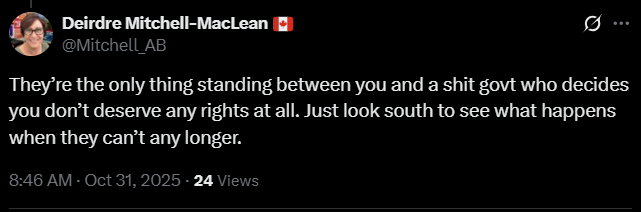
Parliamentarians have the power to create laws, but the courts can also be asked whether a “democratically elected government” is unnecessarily impeding on the rights and freedoms of those it governs. “Unelected judges” are there to interpret legislation, and if they’re asked to do so with the Charter in mind, no matter which party is leading the government they should respond. Their decisions can help protect all citizens from governments who would use their legislative powers to override our rights and freedoms despite not being able to argue that it meets the standard of reasonable limitations.
Manufactured balance
To Mr. Kenney’s point, the op-ed he mentioned takes the position that because the responsibility to provide peace, order, and good government resides in Parliament and the provincial legislatures, they will do so. That’s a level of faith I’m not willing to hand over in 2025.
Yet, we’ve seen numerous instances within the past five years alone where what the government may deem as providing “peace, order, and good government” is not in line with what the population believes. This doesn’t have to mean the people are right, but that is what the courts are there for — to hear those complaints and provide a legal interpretation if asked.
It does not stop the government from using the notwithstanding clause after the courts weigh in. That is the reason the notwithstanding clause exists; to allow the government power to override the courts.
What Mr. Kenney, the United Conservative Party, and the op-ed authors are arguing for is not parliamentary “responsibility” but “discretion”. More specifically, that the public should not have the right to know when proposed law infringes upon their rights. The op-ed authors mentioned an Ontario Court’s ruling on the removal of bike lanes, but neglected to include one most Canadians would know about: a Federal Court’s ruling against the federal government’s use of the Emergencies Act.
One would think that the decision in one of those was more worthy of being included than the other.
I’ll reiterate that the decision on bike lanes does not bind the Ontario government from using the notwithstanding clause to refuse to protect its citizens with designated spaces for alternative mobility. The court’s decision does not change the fact that they can still do whatever they want to do; the only thing that changes is that the public might not consider it a violation of their rights, or an abdication of responsibility by the governing party, without the court.
That is the only benefit afforded to cutting out the judiciary and it’s the only benefit of preemptively using it in legislation: to keep the public from knowing that the government chose to ignore the rights of those targeted by the legislation.
The government retains this privilege with and without the court’s interest; the public does not.
On the surface, the op-ed may look like it’s offering balance but it’s a MACK truck speeding by the topic at hand. It’s not balance. It’s not relevant. And at least when I used it to sideline a conversation, it was true.
Thanks to everyone who reads, shares, and becomes a free subscriber. Please consider becoming a paid subscriber to support my work; to those who have, your support is greatly appreciated!
Thus did it dawn upon me that there might well be a whole other nuance to the country & western song ‘AlberDUH Bound.’