

I only knew Darren Markland from social media; that weird space where you get to know only as much as someone else is willing to share. I suppose that’s not entirely different than meeting someone in person, except that people share more with strangers online than they can with a stranger in person before they are well on their way to becoming something else.
In the real world, a stranger could be just outside your orbit and never know more about you than perhaps a fleeting recognition of having seen you before. In the real world, you might never know you’re sitting right next to a person you only know online.
I don’t have any anecdotes or memories to share about Dr. Markland because I only knew him through the stories he told. Through them, however, he had a personal impact on me.
I discovered his social media during the pandemic when he shared stories from his daily life as an intensive care physician in Edmonton. It was during a brief space and time since I discovered politics that I didn’t want to hear a thing from politicians or political types (and that’s saying a lot).
Whether it’s books, movies, a sitcom, or music, I appreciate stories and storytellers.
Dr. Markland probably had many gifts but the one that shone on social media was his storytelling. He had a way with words, conveying so many feelings with apparent ease. He spoke of loss, perseverance, sadness, hope, grief, and strength, not just through his own eyes but also with an effort to share that of his patients, their families, and his colleagues.
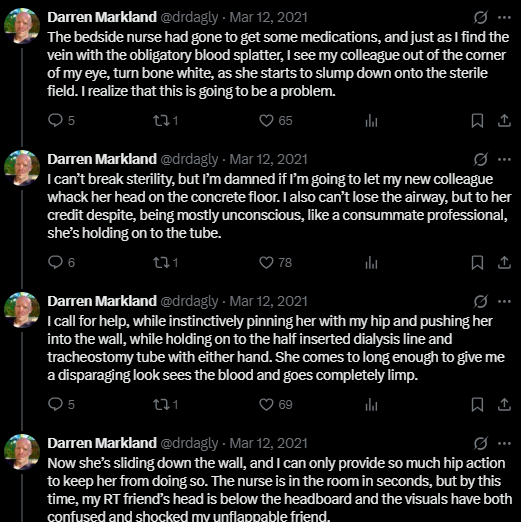
His ability to bring those stories into the public sphere was desperately needed — whether humourous or heartbreaking — because back then only those inside of hospitals could share them.
He was not just descriptive, but insightful.
While most of us were shielded from directly experiencing the pandemic personally, relying instead on numbers and statistics, and the strategically calm delivery of our Chief Medical Officer of Health, Dr. Markland shared a first-hand account of the human element.
He reminded us that for him and his colleagues, those numbers had faces, feelings, and families.
It was a time when we needed to be reminded that it wasn’t just about numbers, a system under strain, or buildings and beds; it was about people. People who were ill, people who were worried about them, and people who were trying to help them.
He shared stories in a way that illuminated the struggles of those working in exceptional conditions of uncertainty and stress, and gave a voice to those who were too exhausted, reluctant, or unable to do it themselves.
Through those stories, he not only connected us to their subjects, but also advocated for his patients, colleagues, health policy, and the health system as a whole.
He humanized situations elected officials can’t by focusing on a department name or an abstract system that “doesn’t work”; a department doesn’t exist and a system doesn’t “work” without supporting the people who make it so. His stories connected us to the people he saw, worked with, and himself.
Enviably, Dr. Markland also seemed to have the ability to seek and enjoy a balance.
He shared the comfort of his cabin in the woods where he would go to escape the city, pamper Mr. Hobbes, or head out on another adventure.
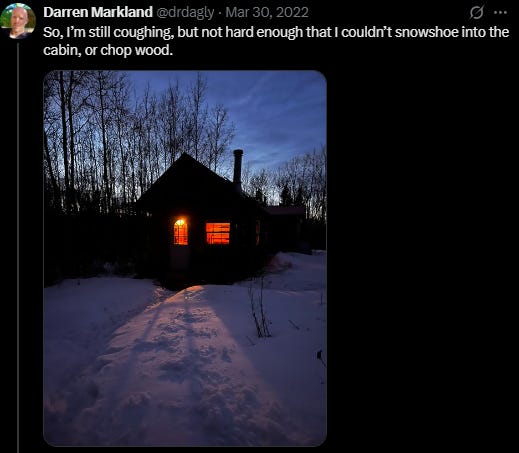
He shared accounts of his adventures with his family, laughed at himself, and invited the rest of us along for the ride. He was good at being joyful, thoughtful, and self-deprecating, but also at being introspective.
Interspersed with his stories from the front lines, or his many outdoor activities, he captured and shared moments of stillness on his daily commute, where he rode through the trees along the river valley.
The path ahead yet undisturbed by a fresh snowfall.
A sunrise or sunset.
A blossom or animal tracks.
In those moments, he was also a poet.
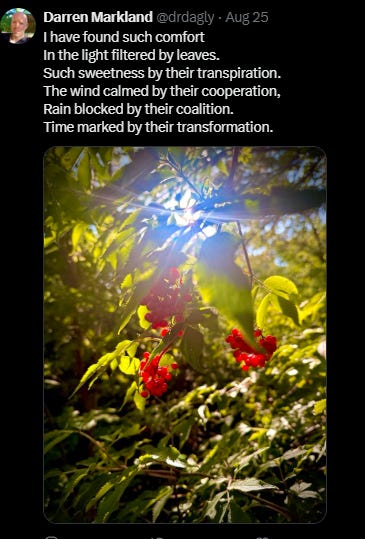
Despite the difficulties he was so skilled at relaying, he would stop to exhale in solitude and he shared that with us, too. That quiet moment, broken only by the words he had to release just then, were just as impactful. It wasn’t simply that he was seeking calm, or reassurance, or inspiration; it was that when he found a sliver of it, he offered to share that with the rest of us, however briefly, as well.
I didn’t know Darren Markland; I only know that he took the time to share his stories, his joy, and his hope, with strangers.
I too only “knew” Dr. Markland from Twitter as he shared his work and personal life with his many followers. When I heard he had died I could not believe how much my surprise hurt … He was that rare person who gave much, much more than he received and I am made better for having known him if only virtually
Like so many others, it seems, I too came to know Dr Markland through SM, during the pandemic. His posts immediately stood out for the grace and dignity of his words, and the profound respect he held for everyone he dealt with.
I particularly remember at least one thread he shared of the dreaded phone call placed to a family member of a patient, to deliver the awful news that their loved one had died. His words conveyed all the weight of the moment and let us glimpse the emotional impact it was having on the health professionals. He simply reminded us, as you said, that within these systems and institutions there are people trying to get along as best they can.
News of his own death hit me hard. He was among the best of us, and I give thanks that he lived. I hope his family can take some comfort in their grief, knowing how many were touched by his gifts.