

Alberta
Every government decision is probably a trolley problem
When I first started writing about politics in 2017, I had this wild idea that I would have a singular focus on Alberta. That well-intentioned plan didn’t even make it six months because we had an NDP government in Alberta and the TransMountain Expansion was not popular in B.C., where they were having an election. The BC Liberal party, under the leadership of Christy Clark, was a proponent of the project, albeit with many conditions. BCNDP leader John Horgan came out against it, a stance some believed was his predecessor Adrian Dix’s mistake in 2013 which led to a re-election of Clark’s liberals. After the dust settled, the liberals had 43 seats, BCNDP had 41, and the Greens ended up with three. Though Ms. Clark could have formed a minority government, Mr. Horgan finagled the support of the Greens, with a promise to fight TMX, giving him the support of the House to form government. That singular issue forced me to keep an eye on what was happening in other provinces, and what the federal government was doing, which, in turn, required me to follow U.S. politics off the side of my desk.
One of the benefits of being government — scratch that — a conservative government in Alberta is that they get to feign ignorance of how interconnected we are, not just as a country, but as a global player. Oil prices aren’t set by us, they’re set by how much supply is available on the world market. When Donald Trump put tariffs on items coming into the U.S. from other countries, most people understood that people in the U.S. would buy less. As their economy contracts, it affects us. Even a sovereign Alberta doesn’t have the luxury of ignoring that reality.
When China (yes, I’ve now had to delve into some background on what their government’s been doing) put a 76 per cent tariff on Canadian canola, which they said was in response to Canada’s tariff of 100 per cent on Chinese electric vehicles (EV), I knew that Canada had put that tariff on in tandem with the U.S., who was trying to protect U.S. automakers, to which Ontario manufacturing is tied, but also affects Alberta car dealerships — the same people who gave a few hundred thousand dollars to a political action committee (PAC) to help elect Jason Kenney and the UCP in 2019 — who sell those vehicles in a province where the internal combustion engine is king, because we sell the oil.
Knowing how intertwined these decisions are, I initially expected Alberta Premier Danielle Smith to suddenly not have an opinion on the situation. Silly me. Saying that the Liberals should repeal the tariff on Chinese EVs was the perfect opportunity to really own the libs and she was all over it.
This is the first time Danielle Smith has been able to look like she’s putting anyone else before oil and gas, and it’s a pretty safe bet that she won’t have to deal with the consequences of getting what she says she wants. She’s likely banking on the fact that Canada cannot remove the EV tariff without earning the ire of the U.S., who we are already having issues with and are supposed to head into trade negotiations with next year. As safe bets go, it is almost assured Prime Minister Mark Carney cannot do what Danielle Smith claims she wants (she doesn’t), because he has to play a balancing act with Ontario, Alberta, the U.S., and China. He doesn’t have the luxury of pretending there are no consequences for his decisions.
It’s the trolley problem in action. Prime Minister Carney has four tracks to choose from: running over people in Alberta and Saskatchewan, people in Ontario proper as well as the other parts of the economy that supports — car dealerships, parts stores, garages, and Alberta’s oil and gas; a giant boulder on the U.S. track, or the great wall of China on the last one. Those are his only options.
The trolley is not getting past the boulder or the wall. The auto sector in Ontario not only supports Ontario workers but thousands of others in dealerships in every province, parts stores, garages, and the almighty internal combustion engine requirements of a steady stream of oil and gas clear across the country. What’s left? Canola farmers, because it has the fewest people on the track.
Though I’m sure this analogy might seem like a boon for the separatists, if Danielle Smith was Governor of Albertaville, she would take the exact same track because oil and gas provides more to the treasury and she’s never going to risk pissing off the country that buys it, either. If the government of the province’s biggest market asked her to support them by implementing a tariff on another country’s product, she would.
“(Alberta politics) was never this cynical or mean-spirited”
I was this close to being drawn into that sentiment, from Sean O’Shae, on how Alberta politics looks from outside the province. I like to think that the best formulation of elected representatives we’ve had was the mix from 2015-19, when there were NDP, Wildrose, PCs, Liberals, and a smattering of Alberta Party MLAs. I felt the nastiness then, too, though; anger, disdain, and incredulity that another party thought they could govern Alberta. Or maybe it was that they were a non-conservative party. Or that there were so many women. Maybe all of the above.
It didn’t go away when conservatives were returned to power under Jason Kenney, either. If anything, it felt worse because there was a feeling that the governing party wanted to extract revenge on the opposition for being elected, for governing, maybe even just for existing.
Jason Kenney had a thing for Ralph Klein. His intention, at least at the “Ralph Klein Revival” in the fall of 2017, was to follow in the former Premier’s economic footsteps, yet he brought more than that to the table after his party formed government — he brought the pettiness and disdain I didn’t know existed then.
After the 2004 election, government MLAs were given heavy gold rings, graduation-style, denoting their elected office and paid for by the public. Opposition MLAs were given no rings, even though they are elected to the same office and sit in the same legislature. Those rings delineate a caste system that taunts centuries of hard-won parliamentary tradition.
During the centennial celebration in 2005, all MLAs were given medals to present to notable constituents. Conservative MLAs were granted the use of Government House -- a public facility -- as a venue to make the formal presentations. When Liberal MLAs applied to use it, they were denied permission. Such humiliation may seem petty, but it exemplifies a dangerous petulance toward the elected opposition, and a post-democratic frame of mind.
…
Even if the Conservatives survive their divisive leadership process, it’s an open question whether they could survive a focused, competitive two- or three-party electoral process.
Which raises two questions: Is Alberta just one great opposition party away from the restoration of democracy?
And what will the Conservatives do to keep that from happening?
In retrospect, Peter Lougheed was lucky. When he and so many others built the Progressive Conservative Association of Alberta, the province already had a space for those who wanted control over consensus building, and dictates over consideration… but they found their way back into the party, and government.
While I hadn’t thought of it as post-democratic specifically, that is exactly what it feels like when the governing party angrily mocks those who oppose rather than accepts that they are mistaken.
Take the failed first attempt at the book ban for example.
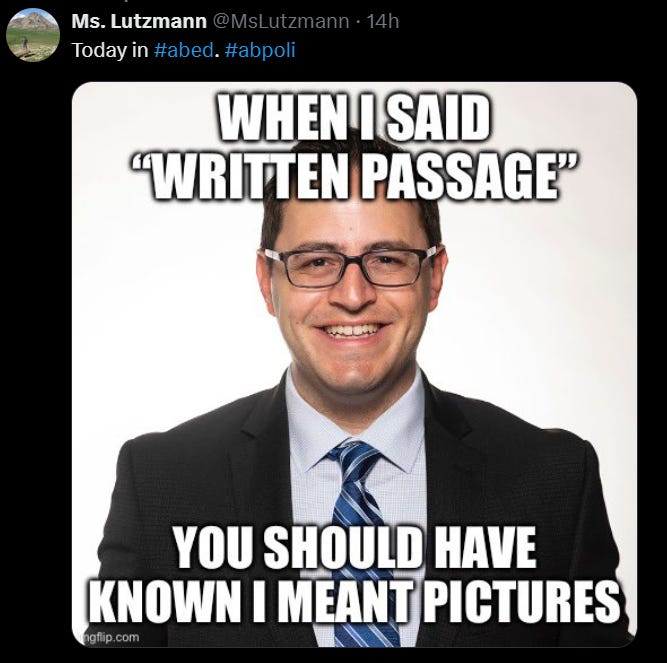
The Premier has been exceptionally snippy about the failure of her government to target the specific books the UCP and their special interest groups want banned, rather than the once-promised “admit to it, learn from it, and get back to work,” as the “dear-departed Ralph Klein” would have done. They may not appreciate the fact that the Ministerial Order specified “written word,” but their refusal to account for their mistake reeks of an entitlement that this party is supposed to be far too new to have entrenched as easily as it has.
Then again, if you’re just populating it with people who revere an anti-democratic governance model, then it doesn’t really matter what they call themselves, does it?
Canada and beyond
President of EU says there’s a business case for Canada’s oil and gas
I just realized why Alberta’s “ethical oil” argument always seems to fall flat; this argument makes no sense from a province whose governments have been obsessed with individualism and freedom from collectivist responsibilities and obligations. A province that consistently complains about paying the same tax every other person in Canada pays on their income. A province that sits back in silence, or worse, applauds while its leadership denigrates our family and friends who choose to live elsewhere in “have not” provinces.
From a leader who is focused on nation-building, however, it appeals to the far more collectivist nature of the European Union. Of course, they have also realized that by purchasing their energy from a dictatorship, they have been funding the power of that dictatorship.
The same goes for dictatorships on the rise; even if we thought they were our best friend.
In university, I wrote a paper on how Monsanto was able to run roughshod over farmers in North America who didn’t plant their seed, but had it blow into their fields. Farmers were sued, and lost, to the corporate giant. In the EU, however, they determined that there was not an absolute patent protection for corporations, effectively protecting their people far better than the law has managed here.
It’s that type of collectivist sentiment that shows up when we’re choosing products that are “Made in Canada” at the grocery stores, or supporting local by frequenting a “mom and pop” cafe instead of Starbucks. Alberta hasn’t been very good at displaying that sense of unity that smaller countries in the EU rely on because they know it protects them from actual enemies, not pretend ones that help your crappy party stay in government.
While many Canadian government representatives are working toward ways of decoupling our reliance on neighbours to the south and actively building new relationships and seeking new partnerships, others are still moving in the same circles, telling the same stories, and hoping nothing changes.
Healthy economies need independence from partisan political influence
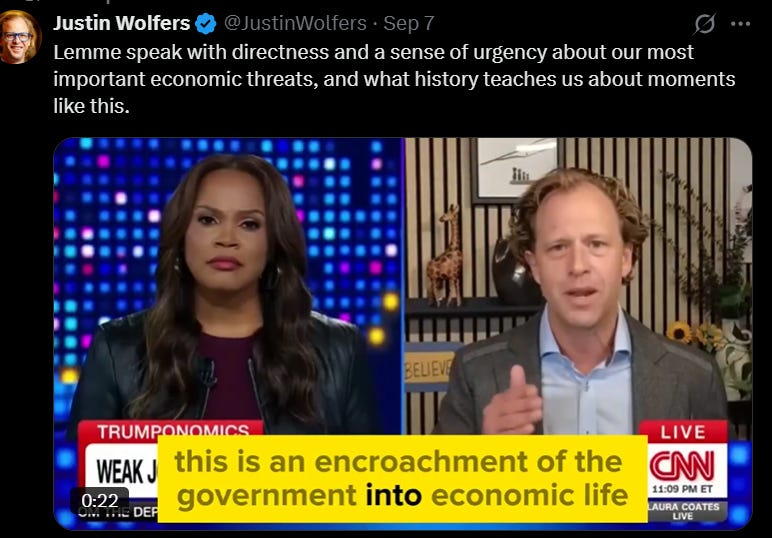
Justin Wolfers from the University of Michigan is my new favourite economics teacher (along with my local favourites, obviously).
We ask deeper, harder, more important questions. Why is the United States rich? Why is Argentina poor even though 100 years ago, it was nearly as rich as the United States was. Why is the country I was born in, Papua New Guinea in grinding poverty?
We’ve studied this, we economists, for decades now, and the overall answer is … what matters is the quality of our democratic, political, and economic institutions.
It’s having independent (agencies and boards) that report true data. It’s allowing people in markets to pursue their passions and ideas rather than having a president decide he wants to tell Coca-Cola which sweetener to use in its beverage, or that it wants to own 10 per cent of Intel, or who Harvard can hire and what to teach, and tell Cracker Barrel what logo to use.
It’s an encroachment of government into economic life, we’ve seen it many time before, in many other countries. It plays out very, very slowly but has very large impacts. It’s the reason some countries are rich and some are poor. It’s not going to show up in tomorrow’s economic numbers, but it will show up by the time our kids get to the table and find that the pie’s a little bit smaller than they were hoping.
Sounds like very, very relevant advice.
Final thoughts

Thanks to everyone who reads, shares, and becomes a free subscriber. Please consider becoming a paid subscriber to support my work; to those who have, your support is greatly appreciated!
Sorry John! I meant to delete my comment but deleted yours instead!
We need to have a discussion on how in the last decade the auto sector is moving towards the production of disposable cars and how they can’t be repaired once the warranty expires. People starting to take notice. The auto industry are making it prohibitively expensive to carry on any type of repairs on your own. They want you to walk into a showroom and buy a new car. Trouble is there’s a significant portion of the population who can’t afford a new car and are in danger of being pushed out of the car market.