

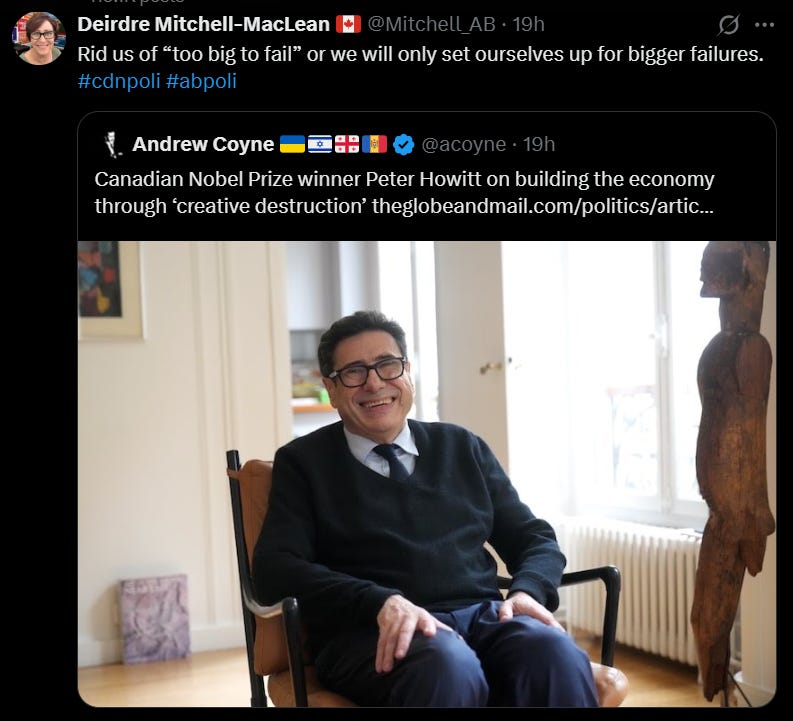
There is a saying that “common sense” is not at all common. We’ve all likely experienced this at some point watching someone attempt to do something we know how to do well and can’t quite grasp how the “easy way” isn’t as intuitive as we think it should be. The same goes with the way people think.
I had a teacher in university who would give half-marks when a student repeated talking points from his lectures on a test/assignment/paper. Essentially, one could pass the class by showing up but could only excel by applying those concepts he was teaching to outside examples. I know it’s not the talking point du jour in certain circles, but he forced us to think for ourselves. At the time, it made his class seem ridiculously easy — so long as we were paying attention in other classes, we could ace his. I now realize we had to actually have a good grasp the concept in order to do that, but for people like me who love to make those connections, it made his class seem like a breeze.
Yesterday, I learned something amazing about economics. I am not an economist, and I don’t pretend to have much understanding of something that requires multiple long-form equations to make sense of it. With that being said, I do understand the logic of an argument, even without having direct knowledge of the subject (which is the basis of the logic problem portion for Law School Admission Tests; the only part of the test I enjoyed prepping for back in the day).
Peter Howitt, a Canadian living in North Carolina, was a joint recipient of the Nobel Prize for Economics based on a paper he’d cowritten with French economist Philippe Aghion in 1992; “A Model of Growth Through Creative Destruction.”
The “destruction” they were referring to is that which is caused by innovation. Think: the horse and buggy industry being “destroyed” by the invention of the motor car or VHS overtaking BETA. I hate that the latter ages me harder than the former.
There’s plenty of examples during my life though; video generally killing the radio star to Michael Jackson’s Thriller video. ICQ and MySpace to Twitter and Facebook. Record companies to Napster to YouTube and Spotify. Giant mobile phones that cost a small or large fortune to almost everyone having a mini-computer that also makes phone calls and fits in their pocket. Innovations that set new standards, and left those who didn’t adopt them in the proverbial dust.
Computers generally. I still remember the first time I said “I bet everyone will have one soon” after seeing a website address on a company’s television commercial. Hah — I remember a time when we didn’t want our names to be accessible on the internet because of “stranger danger” rather than a fear of “being cancelled”.
Just in case you hadn’t figured out I’m GenX before I topped it off with that last one.
“Too big to fail”
In 2008, I was not at the point where politics and current affairs was overtaking my life. Back then I had a six, five, and two-year old and a full-time job. I commuted, however, so I heard things on the radio. I’ll give Hollywood writers all the credit for “The Big Short”, “Margin Call”, “Too Big to Fail,” and even “The Other Guys” for helping to bring it all into pop culture.
Before that, though, I remember the auto bailout, and the umpteenth time Bombardier received theirs. I remember the 2007-08-09 financial crisis. After that, I remember when then-Prime Minister Justin Trudeau attempted to bestow more lenience upon SNC Lavalin.
Because I have to look things up once in a while, I also know that Peter Lougheed received a lot of pushback from wealthy oil producers for being willing to put government funds into developing the oil sands in the early 1970’s. He applaudingly stood up to those with donor dollars to side instead with innovation and the future of our province’s economic health. To his credit, he also realized he had unleashed a bit of a Pandora’s box on the province. His fight against Ottawa became a boon for U.S. investors in the province and also created the lone customer problem we Albertans built entirely out of anti-Ottawa sentiment.
We did that. Not Ottawa, not the Trudeau’s; we, voting Albertans, did that to ourselves in defiance of all logic, and, apparently, all economic sense.
I understood the problematic logic of “too big to fail”. I understood the problem this situation posed for the people who were affected by it, even as I understood the benefit to the companies who profited from it. What I didn’t understand at the time was the economic principles it violated.
Companies and jobs are continually replaced and disappear, and that turnover is the foundation of economic growth. A company that creates a better product or more efficient process can climb to the top of the market, creating incentive for other companies to invest in research and development, and to innovate themselves, in hopes of reaping the rewards at the top of the food chain.
“New economic growth depends upon new ideas. New ideas come from disruptive people that are going to challenge the status quo,” Prof. Howitt said.
“But what happens is that if those disruptive individuals become successful, they become the status quo that try to prevent the next round of innovations from displacing them.”
Globe and Mail, October 13, 2025; accessed October 16, 2025
That’s the key right there; “they become the status quo that try to prevent the next round of innovations from displacing them.”
Not that they are subject to the same principles the rest of us are — adapt or die — but that they somehow manage to have the influence on governments to retain their supremacy even if they are no longer supreme.
It’s like how companies are purchased for far more than they are worth at the time only to see their ideas and innovations suppressed instead of being implemented. In response, economies stagnate. Employers amalgamate, jobs are lost, and nothing really changes other than the hold one has on the economic — and ideological — output.
In essence, every government bailout holds the economy back from the “creative destruction” that would push it forward.
Bring it on
I’m not an economist and I don’t entirely understand what they’re talking about all the time but this made sense to me. We haven’t done ourselves any favours in the past and we need to get out of our own way in the future. That means we take a realistic view and let the free market do what it’s doing to do. We need to let companies and businesses succeed or fail based on the benefits they provide to the paying public rather than the government’s favour.
We also need to demand that no company ever becomes “too big to fail”. If competition builds innovation then let it; monopolies should absolutely be restricted to protect both consumers and the ability to innovate and if the “free market” doesn’t want to play nice, that’s where government should get involved because their responsibility is to us, the voters, not the companies that provide services.
Thanks to everyone who reads, shares, and becomes a free subscriber. Please consider becoming a paid subscriber to support my work; to those who have, your support is greatly appreciated!
Impressive! Thank you. ❤️🇨🇦
Excellent article. Yes, Smith & her government are messing with the economic flow of innovation - particularly in the energy field. Not good for AB and citizens. Why is AB not exploring the manufacture of products from the main resource - O&G? There are about 6000 to choose from. Promoting green energy projects rather than killing them? Smith seems intrigued with the Model T, or horse & buggy …