

I like to remind myself that Danielle Smith was once a “common sense conservative” — or at least gave an Emmy-worthy performance playing one on T.V.. As a surprisingly (considering my area of interest) optimistic person, I couldn’t entirely manage to peg Ms. Smith as the utter train wreck she’s proven to be in government. It was, I believed back when she was first elected, equally as possible as her being a force for credible fiscal discipline. There are times when I’m perfectly willing to predict the future — I did this without issue when Jason Kenney was leader — but in Ms. Smith’s case, her only constant since the pandemic has been contradiction and unpredictability. She was the epitome of the thought experiment around Schrodinger’s cat; both outcomes were equally possible and I had to wait until we could open the box and look inside to know for sure.
Since its absence may not be obvious, I’ve purposefully neglected to use the word “leader” because she’s only proven she lacks the ability to own, let alone accept the responsibility. With that being said, she’s inexplicably managed to convince 96 per cent of her caucus to stick with her, so maybe she did learn something. My most educated guess would be how many skeletons are in their closets, frankly, but that’s a ponderance for another day.
On Monday, October 20, Minister Joseph Schow was tasked with holding a press conference to usher in the next legislative sitting, which begins Thursday. He began with a brief summary of the Bills his government passed in the last session, and offered an introduction of a few of the 15 Bills his government will be tabling over this one.
The one-line summary that caught a lot of attention was the Justice Statutes Amendment Act, which Mr. Schow claimed is needed to provide “further protection for our local elections ensuring only those who truly care, and are serious about representing a community or riding, are allowed on the ballot.” (Emphasis mine). The Bill will be introduced by Justice Minister Mickey Amery and Mr. Schow knew embarrassingly little about it considering he brought it up during a press conference.
Since Ms. Smith and her caucus treat His Majesty’s Loyal Opposition as traitors to the province for daring to question the divine decision-making authority of their government — an affectation sadly not unlike others who have held the roles — and are currently fighting the name change of another political party because they believe they can claim ownership of a term recognized as a political identity they clearly do not represent, there is an understandable level of mistrust as to the intention of such legislation.
There’s also very good reason to question whether this government is thinking through the potential unintended consequences of such legislation; not that I need to remind anyone of their recent fiasco with a book ban.
Finally, that they believe they should be able to prohibit participation in this way is an extreme violation of a democratic privilege that belongs to Albertans — not the UCP government.
Of crackpots and loons
As Don Braid, long-time columnist of the Calgary Herald, noted, “on three ballots — for mayor, councillor and school trustee — I saw only names of people who’ve been campaigning their hearts out for a month,” he wrote Monday.
“Oddly, that was disappointing. Often the crackpots and loons on ballots are the most interesting of the bunch. The absence of eccentrics in this mayoral race, in fact, is one thing that took all the fun out of it.”
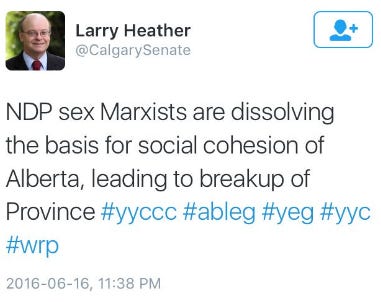
He continued with a story of someone whose name I didn’t recognize; Oscar Fech. My fond memory of a chronic Calgary Mayoral candidate is a man named Larry Heather (who did not place last this year!). Sadly, he no longer has a twitter account so I didn’t even know if he was running.
Then there was also a man named Kevin J. Johnstone who, as a candidate for Calgary Mayor, was threatening AHS employees to the point that the Calgary Police voiced concern and the City of Calgary decided to withhold voter lists from municipal candidates that year. That was when we discovered that anyone can run, and get voter registration lists, without passing any sort of criminal or vulnerable person background check. Great times.
The fact remains that each of these people probably truly wanted to represent the community they believed they spoke for, and each (probably) legitimately wanted to win, despite not having a hope in hell. Therefore legislation wouldn’t necessarily be able to bar kooky candidates from running for office.
Mr. Schow seemed to dance around the question and not in a way that made it seem like they have good reasons for this.
When asked whether the legislation was directed at those who represented the longest ballot committee — a group that showed up in ridings Pierre Poilievre ran in during both the general election in his home riding of 20 years, Carleton, which the CPC leader lost after six straight electoral successes, as well as Alberta’s Battle River-Crowfoot, in which Mr. Poilievre ran for a seat after having its elected representative, Damian Kurek, step down — but had no discernable effect on either outcome. Mr. Schow said he would defer to the Minister for more detail but added his own thoughts.
“In terms of motivation, we have seen instances around the country where certain interest groups have taken (it) upon themselves to confuse I think, in some instances, those who are going to the ballot box and create very long ballots but, in terms of our intent, again it’s to clarify the process, make it easier for people who are genuinely running for office to get on the ballot and convey their message because elections need to be very clear and so does candidates’ interest in why they’re running for office,” he said.
It’s ironic he chose those words: “elections need to be very clear and so does candidates’ interest in why they’re running for office.”.
Initially, I didn’t think about individuals at all. You see, my brain is basically a massive filing cabinet that stores the most random information and, if appropriately prompted, triggers a memory. Joseph Schow reminds me of one thing: “foot in the door” to enact legislation against women’s reproductive health care.
Minister Schow didn’t run on that plan during the 2019 election, however. I only know his intention because he mentioned it to a crowd a few years earlier, when he sought the nomination for the Conservative Party of Canada for the 2016 by-election for the federal riding of Medicine Hat-Cardston-Warner, as noted by David Climenhaga in 2018.
On the point that candidates’ reasons for running for office should be clear, I completely agree. Many people are pro-life. I don’t personally want them anywhere near the legislation, but some people do and they vote. So, on that point, I’m in full agreement with the Minister who decided to run on “values” instead of “foot in the door tactic(s)” but it’s not exactly enforceable, is it?
Since I also remember most of the registered political parties’ names, and since Minister Schow gave this press conference, my first thought was whether this legislation would affect the fate of our province’s special little tax loophole line dancer, the “Pro-Life Alberta Political Association”. Yes… its acronym is PAPA.
Between the years of 2021 and 2022, PAPA received donations of over $670,000. Their final donation summary for 2023 was $451,940, 2024 hit $553,042.50, and up to the second quarter in 2025, they’ve been given $261,691.
The “party’s” website notes that since they’re a “political party” they have an advantage over other forced birth groups because donations to them are eligible for a taxable receipt of up to 75 per cent rather than the maximum of 15 per cent for “charities”.
Pro-Life Alberta readily admits it’s not a typical party. It’s a single-issue group with no intent to form government, Dur said. (Emphasis mine)
But as a party, it’s legally allowed to push its single issue during the coming campaign, and intends to. Without an intent to win, it will define success differently.
“The second-best thing to having your own people elected is to influence those who are elected to advocate for those issues that you yourself would advocate for if you were elected,” Dur said.
Jason Markusoff, CBC, April 26, 2023; accessed 10-21-2025
I doubt that the Minister wants to see this group’s “political status” taken away, yet I can think of no clearer violation of the intention to only allow “people who are genuinely running for office” to have their names on a ballot. If their obviously lucrative fundraising capabilities were threatened, I’m certain they could find 87 people who would be willing to be candidates, too. So what’s to stop them, or anyone else, from doing so?
How will candidates prove they want to be elected?
My optimism seems inexplicable right up until I find something amusing — every time. As soon as I posed that question, I remembered that UCP candidates do not have the best record for showing up to community-run forums during election campaigns. Not that I think there’s any intention to change it.
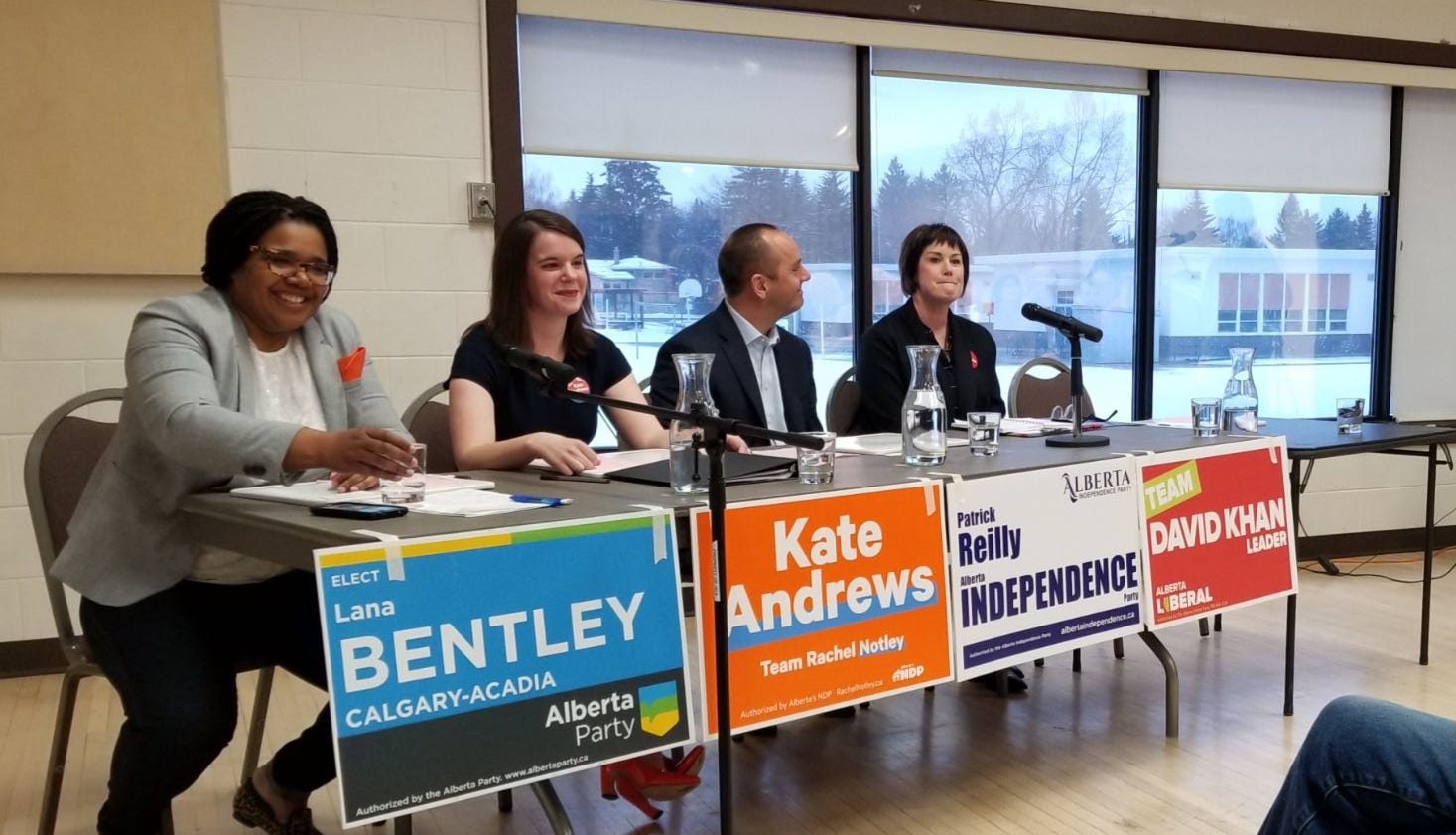
Of course, it’s not just UCP candidates that don’t show up to community forums, and while it’s true, as Matt Solberg said in the linked article, that every candidate’s time is better spent knocking doors, they weren’t facing potential legislation that could force a candidate to prove they actually want to be elected.
In 2015, a newly elected member of the legislative assembly told me that many of the NDP candidates had not expected to win and were not entirely thrilled they were becoming MLAs. In their defence, no one else thought it was possible they might win before the writs were dropped that year, either. Parties can use what we usually refer to as “paper candidates” — people who offer to put their name on a ballot but aren’t expecting to get elected. Political parties don’t generally have trouble getting serious candidates in ridings where the candidate is expected to win — like conservatives in rural Alberta, for example — but they have a harder time in ridings they don’t have a hope of winning; like Edmonton Strathcona.
In the most recent by-election in Edmonton-Strathcona, the UCP offered up political staffer Darby-Rae Crouch. She simply oozes rural Alberta and not for nothing; she’s apparently from Rocky Mountain House but relocated to Edmonton for school and a job with the GoA under UCP ministers.
Would she be considered a “serious candidate”? You’d be hard-pressed to convince me she was. Her candidate website read like someone who was trying to get elected back home in Rocky Mountain House, not an NDP stronghold like Edmonton-Strathcona. I just can’t see the UCP coming up with a useful metric for “genuinely running for office”.
I wondered if they might consider restricting provincial candidacies to people who live in the riding. Doing so might hamper the next star candidate or Premier of Alberta, however. What if they aren’t offered the seat in their home riding, and don’t want to run in an open riding like Calgary-Elbow where they might not win? I don’t see them doing this either, though.
It’s not that I think they might not want to be hypocritical, it’s just that I don’t expect the Premier to green light legislation that could inconvenience her personally.
Minister Schow said this was about “real candidates” but I didn’t get the feeling that this was really about the candidates specifically, or the longest ballot committee, either. Mostly because enforcement would be a joke, but also because of how he hedged around the question. That leaves us with fewer options the government can enforce but also moves the target from individuals to political parties.
The legislation currently states that parties have to run at least one candidate during a general election to maintain their registration — it’s why Edmonton-Strathcona had the lone PAPA, Wildrose, PC, Advantage, etc candidates in the last few elections. They could certainly change that to require “a full slate of candidates”.
Since 2015, only a handful of the many parties registered have run full slates; the PC’s and NDP in 2015, then the UCP, NDP, and Alberta Party in 2019, and only the NDP and UCP again in 2023.
Fielding 87 candidates is not easy, but it certainly can be done. While such a requirement might be one way to clear the path to victory, I don’t think it’s enough for the UCP. In fact, I think it’s highly plausible that someone whose brain is completely pickled with rage that the NDP formed government that one time, that it wouldn’t surprise me to find the UCP are bullish enough to try and ensure no smaller party ever gets the chance to topple a conservative government again.
Therefore, I think their best option is to implement a registration fee; something paper candidates — and fledgling parties — cannot manage. Aside from PAPA, only the Republicans have managed to raise over $150,000 (they’re at $189,000 as of the second quarter). So, how do you ensure only “serious” candidates can run? Create a financial burden to participate.
Even if it was a refundable “deposit”, it could have the desired effect of discouraging the number of people who can run, but would, unlike the other options, be justified as easier to gauge whether a candidate was “serious”. Paper candidates would (in all likelihood) have to be funded by the party, and, if a full slate requirement existed, could genuinely impede a smaller party’s ability to participate.
Any financial requirements would be peanuts to the governing party, who has already raised $4,000,000 this year, but it could be used to ensure smaller parties are unable to ever launch an effective challenge against them, let alone have the opportunity to, ahem, get “a foot in the door”.
Thanks to everyone who reads, shares, and becomes a free subscriber. Please consider becoming a paid subscriber to support my work; to those who have, your support is greatly appreciated!
So cynical have I become about Alberta politics that this year, in the apparent absence of any candidates for The Rhinoceros Party in the municipal elections, I voted for long-time acquaintance, Calgary mayoral candidate, Larry Heather, or better, Harry Leather, as I’ve referred to him for the better part of 45 years amidst his perennial candidacy for every office known to humankind. Although I have yet to see any official results for the entirety of the slate of mayoral candidates in Monday’s election, to hear you report that Larry, or Harry, did not come in “last” prompts me to affirm that my expectations for this most recent exercise in democracy have been more than fulfilled. Now back to re-reading the late satirist, P.J. O’Rourke’s classic, ‘Don’t Vote: It Just Encourages the B***ards.’
I wonder if Damien Kurek was a serious candidate.