

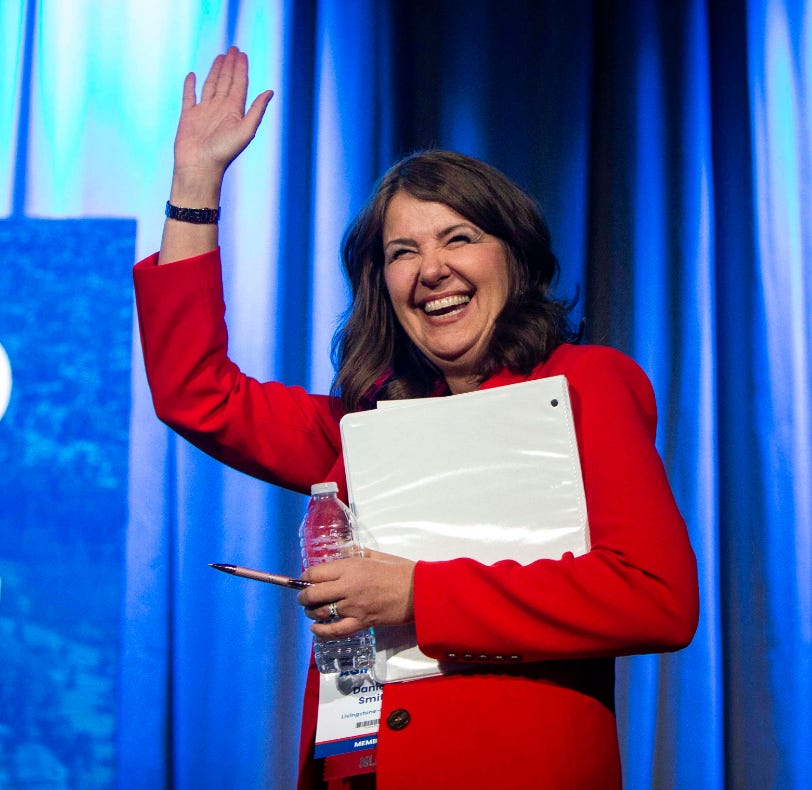
I’m not an economist, so I have little authority when it comes to numbers-shaming. I do know political narratives, though, and the UCP’s budget is an incredible fiscal flop. For the second year in a row, Alberta’s Finance Minister Nate Horner had to try and stand up for a horrible budget that even he struggles to defend. Worse still, he’s forced to defend it not from a fiscal, or needs-based government spending point of view but against his own government’s political narrative.
From the UCP’s performative 2023 Fiscal Framework— which the Minister said they would likely amend because they’re breaking it in spirit, if not legally— to the expectations they’ve set for others, and thereby themselves, it’s a disastrous space for them to be in.
When the NDP posted a $10 billion deficit in 2016, royalty revenue was $5 billion of a total $41 billion in provincial revenues.
In comparison, current provincial revenue is estimated at $74 billion, and resource royalties make up $13 billion of it.
Joe Ceci, the first and last NDP finance minister of Alberta, would have felt right at home giving a speech like (Nate Horner’s). Indeed, he did, on April 14, 2016.
Mr. Ceci’s budget that year had a $10.4-billion deficit, and focused on stimulating the economy in response to sinking oil prices with lots of capital projects. Predictions were that debt would reach $58 billion within three years.
Conservatives went nuts. “Irresponsible and misguided,” screeched a well-known Postmedia columnist. “These giant meteors of over-spending are hurtling towards taxpayers,” Lorne Gunter hyperventilated in the Edmonton Sun. Holy Cow! Giant meteors!
“Today, the NDP failed on all fronts,” moaned then Wildrose Party leader Brian Jean. “Over the long term that means less money for hospitals, less money for schools, for teachers and nurses, for those front-line services that Albertans hold dear.”
“The fact is, the debt will at some point get beyond the fiscal capacity of the government,” warned Ric McIver, then the leader of the Progressive Conservatives in the Legislature, un-factually as it turned out. Debt was “the monster in the room,” he said. “I think that is a disaster waiting to happen.”
I also have questions about the fact that while the UCP is claiming to have a shortfall of only $9 billion, they’re projecting an increase of $16 billion to the total debt. I don’t pretend to know what that’s about.
As the leader of the official opposition, Danielle Smith played the very convincing role of fiscal hawk before she crossed the floor to the PCs in 2014. It was a reputation that managed to stick with her when she was running for the leadership of the UCP in 2022. Of course, she also said the right things when she was campaigning for that role. Things like “if Alberta has $21 billion in royalties, and $8 billion of that is funding government services, then we have a structural deficit of $8 billion that needs to be addressed.”
Kitchen table budgeting tells us that there are two ways to balance: cut expenses or increase revenue. None of us have near the levers of a provincial government, nor the obligations, nor the ability to just keep going into debt, though.
I tried to listen to Kris Sims, Alberta Director from the Canadian Taxpayer’s Federation and I couldn’t finish it. Listening to commentary on a deficit of $9 billion and hearing her get really mad that they didn’t start by cutting grant funding for an artist who received two $15,000 awards, or the employees of a now-defunct central health agency that the same government split into four “pillars” that added as many new government ministers, CEOs, and upper management (with the associated pay bumps), while doubling the costs of surgeries in for-profit clinics, and still wearing the stink of inflated contracts to ONE guy totaling over half a billion on his own… I don’t understand how anyone is expected to take her seriously.
However, that speaks to the power of branding over merit.
Conservative parties have also managed to brand themselves as fiscally responsible and label everyone who isn’t them as spend happy. It’s an easy thing to do when they’re just barking from the sidelines, apparently, but something they have struggled with when every decision is up to them. The Conservative Party is in an enviable position, however, because almost every person who used to demand fiscal accountability from the governing party is now sitting quietly within it and avoiding eye contact.
The legend and the myth
I know everything looks rosier in the rearview mirror, but I simply do not believe that conservative politicians as a whole were ever as bad as they are today. We have far too many today who were raised on utter garbage and no longer appear to have the ability to separate fact from their own political spin. I say this as someone who, in good faith, expected them to. Spin and storytelling, along with some theatre, is part of the fun of politics— I fully accept that and it’s also one of the main reasons I fell so head over heels for it.
What’s not fun is watching them consistently belittle expertise, and reality, in favour of this clown show they’re putting on instead.
Conservative influencers have a saying: you cannot tax your way to prosperity. Fine, but I’ll point out that no one ever said it did. Governments have obligations to the people. Those obligations cost money. The government is responsible for ensuring they have enough money to meet those obligations.
We’ve pretty much been trying to recreate our own Venezuelan paradise but without nationalizing our resources. It’s also how the separatists seem to think we won’t have to pay tax as our own little country. Because it worked out so well for Venezuela. And they all look longingly at Norway’s sovereign wealth fund as if they’d ever achieve that by living off the proceeds. Norway’s fund literally exists because the government refused to spend the proceeds. They tax their population to fund government services instead. But I digress.
The royalty roller coaster, as former premiers Jim Prentice and Rachel Notley described it more than a decade ago, is the big reason why government’s have largely avoided having to make tough decisions about revenue and spending in Alberta. When times are good, governments don’t want to take big risks. When times are bad, governments don’t want to take big risks.
Basically, the entire function of government is responsibility. They are responsible for funding services that benefit the people. They are responsible for ensuring they collect enough revenue to fund those services. They are responsible when they don’t, too.
Ever since Ralph Klein came up with “the Alberta Advantage” to describe our short-sighted over-reliance on oil revenues to pay for services so we don’t have to, it has been worn as a badge of honour by many conservative Albertans. What the politicians and the mouthpieces won’t tell you is that it doesn’t even benefit the average Albertan.
Take the PST for example, which is of course being talked about again, as it always is after bad news budgets. Being the only province in the country to go without would be more of a bragging right if not for the fact that 13 of the last 18 budgets (a whopping 72 per cent) came up short. Same goes for having the lowest (by far) corporate tax rates, and the least progressive income tax structure.
I have a longstanding theory that not having a provincial or harmonized sales tax is a benefit to businesses, not consumers. I was reminded of it while listening to Doug Griffiths, former PC MLA and current President of the Edmonton Chamber of Commerce, on Ryan Jespersen Friday. Mr. Griffiths noted that most businesses don’t want to have a PST because it makes more work for them generally, but he added specifically they would have to “adjust their price point”.
Read it again.
I ran a little experiment one day with my shopping list in 2024. I wanted to test my theory and chose to do it at Wal-Mart because there is a store in every province. I found a nearby residential address in each so it would add the PST/HST and wrote down the cost of my cart. It was the most expensive in Newfoundland, followed by Alberta. My cart was the least expensive in the highest taxed jurisdiction in Canada— the province Alberta conservatives want to be like most in every way (except speaking French and taxation)— Quebec.
Aside from the highest and lowest, the rest of the carts in each province only differed by a dollar or two. How is it that Alberta would be the second most expensive without a PST/HST? Because retailers pocket the money that would otherwise be sent to the government. That’s the Alberta Advantage of not having a sales tax; not for consumers but for businesses.
Conservative politicians— I assume on behalf of their corporate donors— have poisoned the well completely on a sales tax as if it benefits the public in some way. It doesn’t. If sales taxes were really the nightmare scenario the CTF and Alberta conservatives consistently claim they are, every other province and territory in this country, and every state in the U.S., should have completely failed by now.
Alberta, we have a revenue problem
When Jason Kenney tasked his “Blue Ribbon Panel” with recommending cuts to the provincial budget, even they couldn’t stop themselves from adding that Alberta really needed to take a look at the revenue side as well. Janice McKinnon, the former NDP finance minister who slashed Saskatchewan’s public spending back in the 1990’s. The major difference between Alberta in 2019 and Saskatchewan in 1991 of course is that Alberta has untapped fiscal capacity and Saskatchewan’s population barely grows, despite the fact that the province’s birth rate exceeds the death rate.
Alberta Views formed their own panel in 2021 and allowed them to consider both sides of the ledger. Unsurprisingly, they agreed that Alberta needs to raise revenues. Economist Trevor Tombe has been sounding the alarm on Alberta’s financial situation for as long as I’ve been following him, which is at least eight budgets long by now. His opinion has always been that Alberta can and should work to run an efficient public services but that governments in this province need to stop kidding themselves that they can ignore the lack of revenue.
With this budget, the UCP has pushed Alberta’s debt over the $100 billion mark and there’s no plan to stop. Over the coming three years, they’re planning to grow our debt load to $138 billion.
So many conservatives point to Ralph Klein’s great achievement of paying off Alberta’s debt but few will acknowledge that he didn’t manage it through thoughts and prayers. PC Premier Ralph Klein’s predecessor, PC Premier Don Getty, raised taxes and then Ralph Klein replaced him with a plan to use those increases to pay down the debt. “King Ralph” also presided over a natural gas price boom while starving infrastructure, staffing, and program spending.
Those deficits also had to be repaid because Alberta was a growing province and we needed the infrastructure to do it. It should have been obvious since “paid in full” didn’t last.
As such, I would not be surprised if Danielle Smith added a question about a PST, or tax increases, to the October referendum.
It relieves her of responsibility for making a tough decision and completely messes with the opposition; two things that really matter a lot to Danielle Smith.
Now I’m entirely convinced. Bookmark it.
Note: I am just as surprised as anyone else that this is how it ended. Wild.
Thanks to everyone who reads, shares, and becomes a free subscriber. Please consider becoming a paid subscriber to support my work; to those who have, your support is greatly appreciated!
Hey Smith could not run a one grill limited capacity rail car gimmick of a restaurant. She is fiscally inept and wastes every tax dollar that we pay to the province or city that then gets routed to Edmonton re property taxes. Now add the debt interest as well. Meanwhile an easy way to increase revenue would be to increase corporate taxes to what they were before she reduced them down to 8%. She cares nothing re the plight of Alberta taxpayers as she screws over the disabled, seniors, the sick, etc. but God forbid wealthy oil and gas companies pay more in corporate taxes while she wants us taxpayers to pay oil and gas’ costs re orphan wells and tailing ponds clean up which is estimated to be in $100-$130 billion range. Voting against one’s own best interests again and again and against saving lives of your own loved ones re healthcare and senior care re assisted living is beyond stupid. Voters in this province are so brainwashed. Time to lose the “own the libs” mentality.
Mr Klein also had the advantage of high natural gas prices and their attendant royalty payments. He also ignored a few billion in debt that had accumulated because conservative governments had neglected to contribute to the ATRF for several decades.