

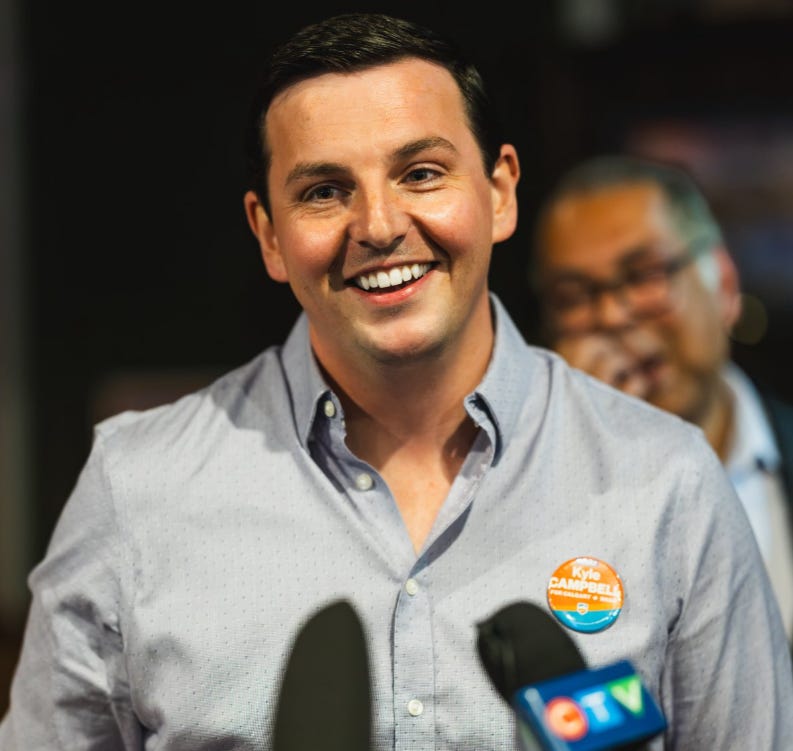
First off, congratulations to the NDP’s Kyle Campbell and thanks to everyone who put their name on the ballot. The people who show up make all the difference in our democratic system.
Now... onto the rest.
Oh the humanity. And the takes.
Good thing I don’t mind crowded spaces.
“The polls were wrong!”
“It’s the Tory Party’s fault for splitting the vote!”
“Where did all the late votes comes from?!”
“This is because of immigration!”
“It’s Danielle’s fault for cozying up to Carney!”
“It’s Danielle’s fault for running a separatist!”
“It’s because of the separatist referendum!”
Woof.
Let’s start at the beginning.
Don’t blame the polls
I learned during the General Election in 2025 that pollsters don’t poll at the riding level. None of them do.
The only way to get that data would be door-to-door and the costs would be astronomical with few people willing to pay. Also, it would take local knowledge to even get a good sample; some neighbourhoods lean one way and if they over-sampled that one, it would skew the results. It’s also difficult to get an accurate sample when the outcome looks like it could be close; it’s like all the proof you need that every vote does count. In order to get an accurate count, one would have to ask every house and hope they were willing to not just be honest but also rely on them showing up to vote (and fewer than 65 per cent usually do).
All that is to say it would be a lot of work with little opportunity to be able to predict the outcome with more accuracy.
What pollsters like 338 do instead is look at whatever provincial polling they do have, perhaps considering any trends, as well as the data from the previous election (which is solid because it’s voter turnout and how those people voted— the “only poll that matters” and all that), and try to make as educated a guess as possible how that riding will turn out.
With so many unknowns— the biggest being actual turnout— a riding-level prediction is, at its very best, only ever an educated guesstimate.
Vote splitting does not exist
People who think the Tory Party took votes away from the UCP, or the Liberals took votes from the NDP, are wishing that those voters would show up and support the party they like instead. That’s cool.
A better question (and conversation, in my opinion) is “why didn’t they?”
Danielle Smith made it illegal for another political party in Alberta to put the word “conservative” in their name. She says it’s because it would be “confusing” but in my experience, no one is anywhere near as confused about anything as the Premier of Alberta. And I’m just basing on that how often she claims others are confused about something almost no one is confused about.
No one is seriously saying that those who voted Tory were “confused” about their options.
And here’s the thing— those who showed up and voted Tory could have voted UCP.
It was an option on the same ballot they received when they voted Tory. Those voters, and the ones who voted Liberal, and the ones who voted NDP, and the ones who voted for the independent candidate, chose not to.
They may as well blame those who voted NDP for not voting UCP.
Oh wait… that actually happened, too.
Jason Kenney’s theory when he merged the PCs and Wildrose was that it would be easier to remove the competition rather than doing the hard work to actually prove to voters that they are the better choice they claim to be.
Today, he chose a different tack.
Folks planning to vote “to send a message” by starting the separation process: please take note of the NDP’s win tonight in the most conservative part of urban Canada.
A vote to separate is a vote to help the NDP win the next provincial election, and for the Liberal Party of Canada to win far more Alberta seats.
Supporting separatism:
- Splits the conservative movement- Pushes many patriotic conservative voters to support the Liberals and NDP
That’s not how to make Alberta stronger, but weaker and more divided.Jason Kenney on X, September 15, 2026
I guess kudos for not blaming the Tories?
The partisanship is still mind-numbing. If having a “natural governing party” isn’t great for a country, it’s no better for a province (even if you’re okay with it because it helps your side). Every elected official should be scared to do things they weren’t elected to do because they might lose their seat.
They should also take the hint and leave gracefully afterwards.
I don’t care what banner they fly or what identity they choose for themselves; when an elected official isn’t afraid of being held accountable, that’s a very bad thing— for all of us.
Grasping at straws
A couple of Conservative “influencers” started steering the train to crazy town. One attempted to cast doubt on the outcome because of the “large batch of votes” added before polls had finished reporting. That large batch was advanced votes, which, just like individual polling stations, had to be counted all together, and the count is released only after it was complete.
43 per cent of the total ballots cast in the by-election were cast in advance polls. Just like individual polls on election day, it’s poll-by-poll as it’s completed, they don’t release the numbers half-way through.
The second influencer I saw blamed immigrants.
Maybe he saw an opportunity to double down on the referendum questions, or maybe he’s just an arsehole. It could be both. I can’t say for certain but if Jason Kenney wants to focus on something that makes Alberta “weaker and more divided,” there’s an empty space being filled with some awful rhetoric that could use some pushback.
But what does it mean?
By-elections can be a gauge of public sentiment in the moment, just like a poll. The UCP had the incumbency and they lost it. That’s not a small detail.
However, there could be a few reasons the UCP lost; turnout, waiting nine months after the former MLA, Minister of Oil and Gas— I mean Environment and Protected Areas— resigned, the bait and switch from a mainstream conservative party to a separatist-friendly party that foists a referendum on a province they had no mandate for, or that their candidate’s federalist feelings were in doubt (exactly like the Premier’s); any one, or a combination of, are good reasons why the UCP lost that by-election.
For the NDP, a protest vote yesterday could disappear before the next election.
Those are some things it could mean.
What it certainly means is that the NDP have secured their claim to a positive narrative today— and until the next election— and the UCP’s will be a little weaker for it.
The same would have happened for Naheed Nenshi’s leadership; the narrative would have suffered if the NDP had lost.
It would have fueled resentment from inside his party that he wasn’t delivering on what he was elected to do. That’s already happened before.
A win would have offered the UCP a narrative of strength.
If the UCP would have won, they’d be saying that Albertans showed their support for the direction the UCP is taking us. They would have said it was validation that Albertans are on their side.
The loss takes that away from them and offers it to the NDP.
I do find it interesting that UCP supporters are also blaming Danielle Smith, albeit for the exact opposite reasons. The UCP is in trouble; and if the UCP is in trouble, then so is Danielle Smith.
It’s about freaking time.
Thanks to everyone who reads, shares, and becomes a free subscriber! Please consider becoming a paid subscriber to support my work. To those who already do, I cannot thank you enough!
Thanks for your comments about vote-splitting being a fiction…far more articulate than mine.
Dance like the whole province is watching!!!🕺