


Education has been much more important to me since I became a parent than when I was actually in school. My eldest two were born in the U.S. where educational inequality is literally built into communities by basing funding on property taxes alone. As such, I knew I wanted to be back home before the kids started school.
In retrospect, it was being faced with that systemic inequality that made me respect the opportunities I had, and the standard I wanted for my children, more.
I had to have known that the inequality in the U.S. education system was a choice. I suppose the difference is that I hadn’t watched the government make those decisions and create that inequality in real time. Unfortunately, it’s something we have a front-row seat for under the United Conservative government.
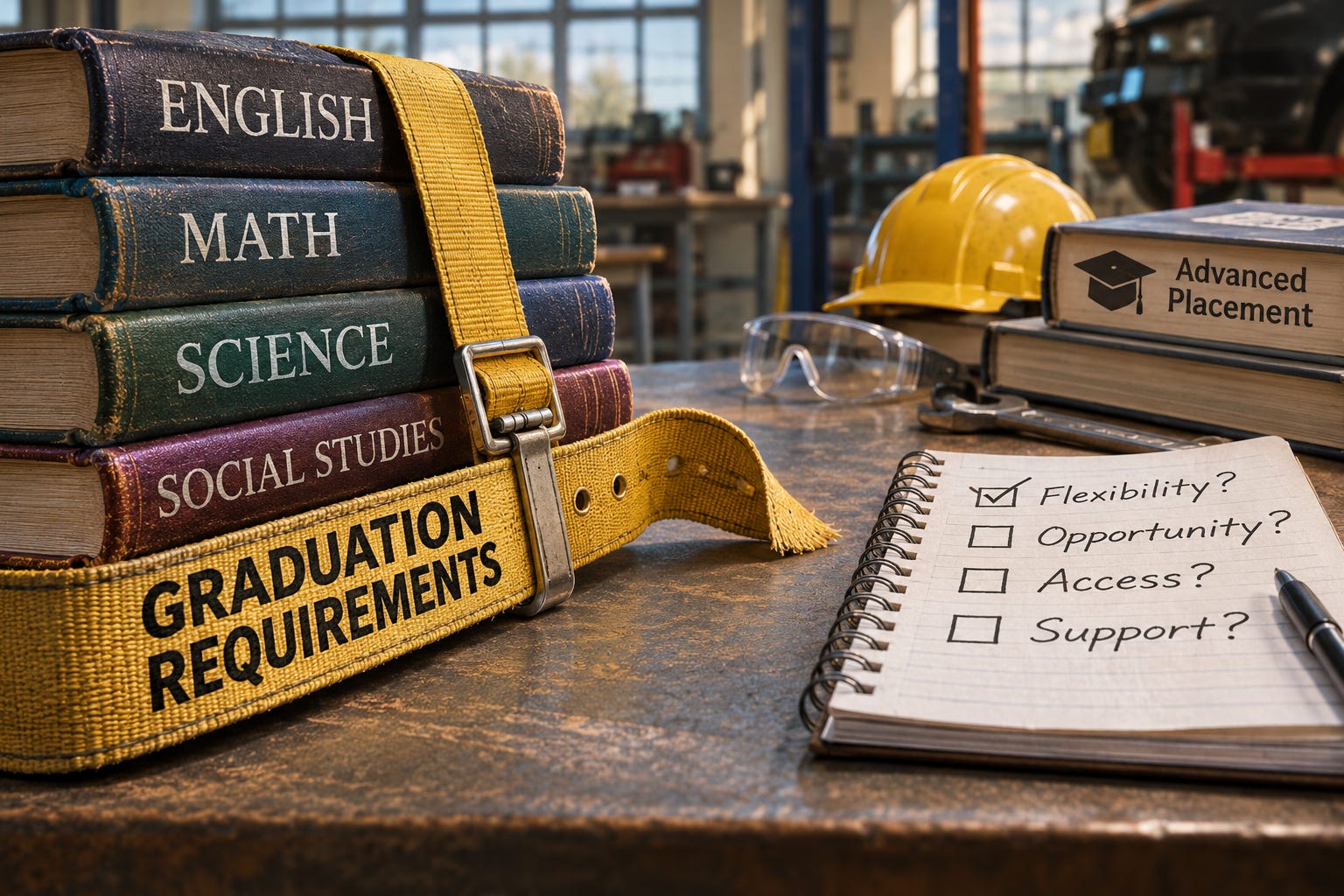
As I listened to Education Minister Demetrios Nicolaides’ announcement Friday that graduation requirements for Alberta students would decrease beginning in 2028, my initial concern was that it would devalue a high school diploma. The Minister claimed that wasn’t the case at all.
“More flexibility does not mean lower expectations,” the Minister said. “Students will continue to build strong basics in core classes and will have to write at least one diploma (exam) to graduate.”
If you’re into the idea that words have meaning, “at least one diploma exam” is a distinctly different— one might even call it a “lower”— expectation than students having to write “at least two” diploma exams to graduate.
“These changes will give students more choice to find their passions, prepare for further schooling or rewarding job opportunities.”
I am a bit of a stickler for words having meaning myself and I have to ask: how does reducing graduation requirements produce “more choice?”
Especially when you consider that the UCP has deliberately chosen to fund students in Alberta’s public schools well below the Canadian average— lowest in the country, in fact.
Does not having to write an English diploma exam make a fully-equipped autobody/mechanical facility appear? How about an advanced placement psychology course?
Not so far as I can tell.
So, while the UCP wants to reduce the requirements for core subjects, what are they planning to replace them with, and are they going to be more useful to students?
Something old, something new
When I was working for the Learning Clicks program at Advanced Education, I didn’t run into “academic” schools until I moved to the Calgary area. I’d started in the Red Deer region and in nearly every high school classroom where I’d mentioned RAP (registered apprenticeship program), I’d usually be met with nodding heads. Students knew about the program and, by grade 11, those who were planning to pursue it were either already enrolled or planned to be. Those schools typically had the facilities and teachers to offer the options, of course.
Urban schools were different. Those that wanted to offer introductory trades struggled to get (and maintain) funding, while others wanted nothing to do with creating the programs in the first place because they were focused on “academics.”
Those schools may bring in more advanced placement classes for post-secondary preparation, or other options like outdoor education, or forensic or computer science instead.
Smaller schools can do that as well but it doesn’t always mean having a teacher in a classroom. What I’ve seen instead is that they offer the options online. It’s sort of a “choice” but not in the same way it might be for another school.
Though that may offer more opportunity for those who enjoy learning online, it doesn’t replace some of the offerings that require specialized instruction, equipment, and space. Up-to-date technology, software, tools, books, supplies, expertise… they all cost money; and that hasn’t been something the UCP has offered.
Albertans are still waiting for them to deliver actual learning space, educational assistants, and teachers to help get our kids through what is currently available.
Removing barriers to graduation doesn’t address the issues we already know exist and it certainly doesn’t prepare students for an uncertain future.
I’m struggling with the logic because I’ve been there
When I was in school many, many years ago, we had an “advanced” high school diploma and a “general.” I took the “general” because I had no intention of taking either a math or science-based program in post-secondary and I didn’t see the need to obtain those credits at the 30-level.
Ask me how surprised I was to learn I would have to take statistics. Or a “science for humanities majors” that for some effing reason included half a semester of bio-chem. I passed it, mostly thanks to my ability to break up words and understand their roots, but I was not happy.
I was not happy that I’d been led to believe I didn’t need certain courses in high school, only to discover that I would have, in fact, benefitted from taking them.
Minister Nicolaides said that students who were preparing for certain education streams would be aware of the requirements and choose to take those classes in high school.
My dude, I prepared for a certain education stream— English— and ended up in sociology with a philosophy minor. One of my classmates began in economics and moved to sociology. I knew a machinist who was working his way through a psychology degree.
High school is supposed to be a place that prepares students not just for what they expect but the unexpected. It’s a building block that should be setting everyone up for success.
Though the UCP could reduce mandatory core requirements while improving educational quality through other means, they have neither demonstrated how these changes will maintain educational standards nor ensured equitable access to the additional options.
To my way of thinking, lowering the expectations for graduation isn’t about offering students “choice,” it’s the UCP avoiding their obligation to provide a properly-funded educational experience for our children— one that adequately prepares them for whatever their future holds.
Not just the opportunities the government is willing to fund in their school.
I’ve said it before about Danielle Smith’s government; it’s brilliant politics but it’s fucking awful leadership.
Truly, the only thing that hasn’t changed.
Becoming a paid subscriber not only supports my work but makes it possible for me to report from places none of us want to go. To those who already do, I’m grateful!
Anytime education and the ucp come up in the same sentence my mind wanders to the Talibangelicals home schooling and now granting degrees.
I recall once reading a significant difference between an English and a North American education.
North Americans are streamed into pathways. The English go to school to read and be broadened. Exposed to thoughts, concepts, philosophies, science, wonder and curiosity.
So to the ucp reduction and broadened prospects. Perhaps I should have studied more because I’m pretty damn sure reduction lessens choice.
But then again I don’t see the world through dystopian ucp eyes.
at this point malicious stupidity is a compliment because only Smith can be this monumentally stupid as to think this is enough to get moderate voters back on her side
Do you know how many houses in my neighbourhood I walk by with signs about wanting change in approach to education or just generally wanting proper funding to Public education?
Spoiler it’s more than I can count on my two hands so ya at this point it’s either she is this stupid or genuinely this out of touch, take your pick people