

When I started writing earlier this week— before the latest polling from Nanos and Angus Reid was released— it was titled “Pierre Poilievre’s time is running out”. There was a moment when I was listening to Curse of Politics about the shadow cabinet shuffle where I thought, “maybe he can hang on a little longer.” With the elevation of more senior caucus members like Michael Chong, or likely talented individuals like Shuv Majumdar who worked with Stephen Harper, it seemed to signal enough maturity as a leader to share some of the spotlight.
Then those numbers came out and I couldn’t even be charitable about it.
Nanos’ “preferred Prime Minister” (July 24) had Mark Carney +2 to 54 per cent and Mr. Poilievre -4 to 18 per cent. Not that Mr. Poilievre was all that popular a year ago— or ever— but he had a lot more room to grow than shrink and he chose the less desirable route.
Obviously the situation was not ideal, but it’s not like we’re near an election anytime soon. Sure, he briefly tried to take on the role of a serious politician earlier this year before abandoning it (because he wasn’t immediately rewarded?) and he’s lost five caucus members, and Jamil Jivani is just out there doing his own thing, and no one really seems that thrilled with him outside of his echo chamber… now where was I going with that? Oh, right; but since he discovered and nurtured the Maple MAGA crowd, no one is taking him out.
Pierre Poilievre isn’t Andrew Scheer trying to step into Stephen Harper’s shoes. He’s not Erin O’Toole trying to win an election with a Reform-leaning caucus. Mr. Poilievre is a weak leader who, as Kory Teneycke ruthlessly pointed out, surrounds himself with people who are actually weaker than he is— because it makes him look better in comparison— but he owns the Maple MAGA folks and they comprise half his party’s support (not unlike Danielle Smith’s UCP). He brought in ideologically-affiliated candidates to secure his leadership and he’s not going anywhere if he doesn’t want to.
The shadow cabinet shuffle, however, was at least a positive move because ineffective opposition is not helpful to us as Canadians. Their role is not simply to oppose but to offer solutions that the government might be overlooking. They are supposed to make government better. If it wasn’t for the fact that Mark Carney could authentically adopt a number of propositions the opposition was putting forward, who knows what might have happened last election?
Not that a simple shadow cabinet shuffle could fix the loss of caucus members, or his unpopularity with Canadians, or the mess he made with Conservative voters.
The self owns keep coming
A petty insult towards Conservative voters who definitely were not in the tent to cheer on Conservative Party of Canada leader Pierre Poilievre at the Calgary Stampede, has gained far more momentum than he likely expected. The number of Conservative party members, supporters, strategists, and at least one former MP who have decided to air their frustrations in return has only grown since. If the input of Mr. Poilievre’s campaign strategist during the 2025 election is any indication, they’re still riding far too high on the “successes” of the party’s fourth consecutive loss to hear them.
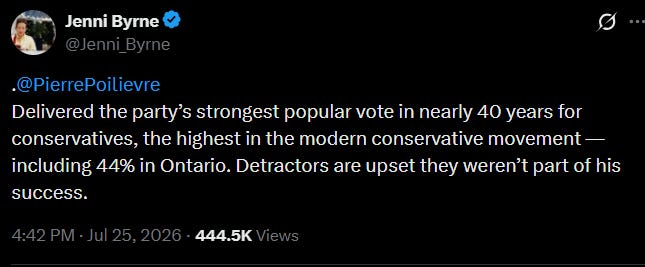
Ms. Byrne is the same strategist who helped the CPC lose the election and apparently didn’t think they needed to worry about campaigning in the leader’s riding; which they also lost. I’m all for focusing on the positive— in theory— but in order to see the whole picture, one has to accept that no amount of successful side quests makes up for losing the entire game.
While it appeared as if the 2025 campaign was run from inside a bubble, there was a brief moment earlier in the year when Mr. Poilievre seemed to understand that something needed to change. He finally let his campaign manager go and hired new communications advisors; months too late, but the pivot finally happened. When it looked like the Leader had no intention of going anywhere, I was willing to see the possibility that his story wasn’t yet over.
Canadians could get tired of Prime Minister Carney in the same way they did Prime Minister Justin Trudeau. NDP leader Avi Lewis could begin to pull votes from the Liberals unlike his predecessor Jagmeet Singh… in time.
If Pierre Poilievre couldn’t have an abundance of votes during the election, or even a subtle indication that he might eventually appeal to a growing number of voters the rest of the time, I suspect he was at least hoping he had an abundance of time.
With no immediate gains from his attempt at a pivot, however, the CPC leader abandoned it. He is currently being propped up by a small but invested echo chamber of support online (who may or may not be Russian bots), and enough people who will show up to a rally for him in Conservative hotspots. Running an anger machine is an impossible task, though, because it constantly needs to be fed new input. And what none of them have figured out yet is that it cannot be turned off.
Facing an increasingly popular Prime Minister, Mr. Poilievre turned his spite and anger towards his own party supporters. The breadth of the response, and the force with which they’ve responded, tells me that the countdown on Mr. Poilievre’s leadership is already on.
The head of lettuce has left the crisper.
Even a bad strategy is “a strategy”
There’s a saying that “those who cannot do, teach.” That should probably be updated to the age of social media to say that “those who cannot do, preach.” Welcome.
I am fascinated by political strategy but I don’t “do” political strategy. I’ve been on campaigns in a few different capacities but I don’t have the “win at all costs” mentality. I can’t get behind false narratives. I can’t look at a field of candidates and pretend I don’t see the likeliest outcome, or a much stronger candidate, and I can’t ignore it when I see the winning strategy, with the winning candidate, on the other team. So, I bowed out of helping campaigns and turned a negative in campaign work into a positive in analytics.
Now, I preach.
I’m not going to say that I predicted Pierre Poilievre’s loss back in December of 2024 because it wasn’t meant to be a prediction— it was simply an observation that the political landscape had changed dramatically. To my way of thinking, we should have been able to expect that Mr. Poilievre’s campaign would, too. Should have, would have, could have.
Trump is quickly becoming Pierre Poilievre's worst nightmare

Picture this: a young teen sets his sights on becoming leader of a nation, planning, and working his entire adult life to achieve it. The stars in his eyes may have dimmed slightly as he began to understand the importance and dignity his achievement will bring, but still, he is determined; even hungry.
What I could see then was that Mr. Poilievre’s campaign required a hard pivot. I was never on board with the “Canada is broken” slogan (and it should have been a loser every time he said it anyway, in my opinion) but from the moment Mr. Trump began degrading our worth as a sovereign nation, it demanded a hard pivot.
At that time, Mr. Poilievre still had Prime Minister Trudeau as a foil but Mr. Trump’s “joke” about the 51st state was notably and increasingly discomfiting for Canadians and signaled a shift in focus from the Prime Minister to the incoming president. It was a shift that Mr. Poilievre and his campaign team were either so deep in anti-Trudeau sentiment, or so convinced of their impending victory, that they ignored it.
I don’t think it can be forgiven that they sat through the Prime Minister’s resignation— which was legitimately the biggest pivot a party leader can make— and still didn’t see that they needed to change course. That’s not just a bubble, or an echo chamber; that’s delusion.
I know a couple of political campaign strategists; I know they map out a plan for the campaign well in advance of actually running said campaign. Anyone with a brain would call this “plan A”. In the ideal situation, the issues stay the same, the players remain the same, and everything the strategist expected to happen does. However, I cannot imagine a decent strategist wouldn’t build in a list of everything that could derail that campaign. They pitch the best scenario and the best outcome because that’s what everyone is hoping for. This is why I believe in focusing on the positives “in theory”.
A candidate can hope for the best— even a campaign team can hope for the best— but a campaign strategist doesn’t have that luxury. They are responsible for preparing for every opportunity and every pitfall. Behind “Plan A”, I would think there is plan B through every letter for every hurdle they can think of. They should never be caught off guard because they should have thought of every potential event that could upend their original plan.
While they probably couldn’t have foreseen the return of Donald Trump or him turning on Canada, the failure to prepare for the pitfall of their own messaging that attacked our country as “broken” is to blame for them even needing to pivot from offence to defence. A failure of hubris or delusion, or both, I cannot say, but it is still guiding Mr. Poilievre today.
And while I’m at it, if conservatives can stop saying Canada “is not a serious country”, that would be great. We have fallen into the trap of electing people who are not taking their roles seriously, but we have always been “a serious country”. Our leaders, both Liberal and Conservative, have made poor decisions that were not always in the best interests of our own sovereignty, but we are Canadian no matter who leads us.
Call out the leaders, call out the parties, but don’t pull a Poilievre. Canada is an incredible country filled with amazing people who are worth doing our best for; no matter how they vote.
You’ve got to know when to fold ’em
It’s rare that leaders who fail to win remain leaders. Mr. Harper lost the 2004 election and was, I’ve been told, ready to resign over it. His closest advisors convinced him to stay and try again. Political fortunes as they are, the party won a minority in 2006, another in 2008, and, finally, amassed a majority in 2011.
In Alberta, Rachel Notley made it past her 2019 loss to fight the 2023 election with over 90 per cent support from those who show up to vote at party conventions (not unlike Mr. Poilievre). In her case, though, she was more popular with the public than her party. Definitely not a position Mr. Poilievre has ever been in as leader.
He may have earned more votes (so did Andrew Scheer for that matter) but no one should be looking at the 2025 election outcome and counting it as a positive for Mr. Poilievre. Canadians wanted a change from Justin Trudeau. We wanted a more conservative government than the former Prime Minister’s— and Prime Minister Mark Carney offered us exactly that.
I made the bold argument that Christy Clark would have done the same (a day before she announced she wouldn’t vie for the leadership). There was the tiny issue of her not being as popular in B.C., but I was looking at the bigger picture. The name may have changed but the argument stands; a leader to the right of Justin Trudeau (and there was room) would pose a real problem for Mr. Poilievre. Not as much of a problem as Mr. Poilievre himself posed for the Canadian electorate, of course, but a problem nonetheless.
That’s what we’re left with now; a real question of what the future of the CPC can be.
The legacy and the future
Mr. Poilievre inherited a divided party (see the 2017 leadership race). He chose the trajectory it has taken, just like the other leaders since Mr. Harper. The difference is that Mr. Poilievre won a decisive victory within the party itself. Through that lens, the Angus Reid poll was devastating by every metric as to where he stands in Canadian opinion today.
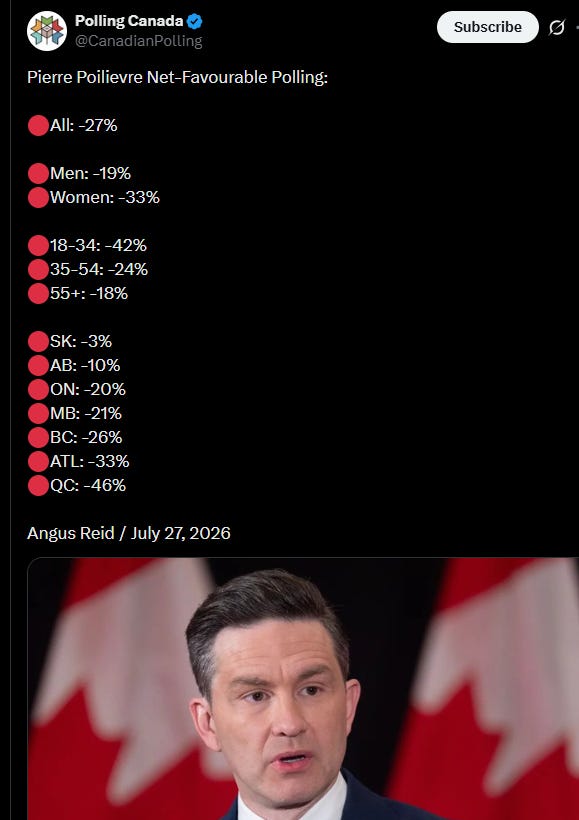
I thought Mr. Poilievre was nearing his end before seeing that the end is here; the party has turned on him because they are still a merged party. That is only reaffirming what the public polling is telling us. For the Leader of the CPC, it wasn’t just a messaging failure— it was a strategic failure that he cannot recover from.
Whenever he chooses to leave— and it will be his choice— there is a huge question around where the Conservative Party of Canada goes from there.
Can the next leader keep their feet planted on both sides without giving way to one? Andrew Scheer didn’t, Erin O’Toole couldn’t, and Pierre Poilievre wouldn’t because the divide is structural; foundational. It’s not as easy as “focus on what unites us” because what divides them is a completely different path forward; maintaining grievance politics or evolving into governance politics. The former is smaller, but potentially more energizing to those who are already all-in, but the latter is what gets you into the seat that gets to make decisions.
If the two are incompatible with one another, you don’t have a party; you just have a problem.
Conservatives will not be in power for a long time. They have proven themselves to be ineffective, incompetent, inept, and ridiculous. There was a time when conservatives were relevant, but that time has passed. They're so embroiled in grievance politics and conspiracy theories that they'll never dig themselves out of the hole they're in. And their base will not let them pivot either. They have the lunatics running the asylum, as Jason Kenney so eloquently put it. Until they can knock off the bullshit culture wars, quit punching down on vulnerable people, and come up with a serious plan that helps people, they'll be relegated to the shithouse. And right now, that's where they belong.
I honestly think the Conservative Party like being the opposition and have no interest in governing as that would mean they would have to deal with criticism and it's much easier to shoot spit wads that to actually roll up the sleaves and do the work of government.