

When Jason Kenney secured the most votes in Alberta’s history in the 2019 election, it seemed like he may have provided the best start to positioning the party as the next dynastic government. It might have happened, too, if not for a global pandemic... and the fact that the reactionaries were more invested in his party than he had adequately himself prepared to manage. Reality came for him just like it did for Pierre Poilievre.
Mr. Kenney had promised to “be humble” and pursue a “servant leadership” role that was thrown out within months of winning. Then came the pandemic.
As an observer of people, I noticed the most amazing thing during those early days; regular people who never think about politics outside of a campaign period were paying attention and they were not happy with what they saw. I have heard that the tide began to turn because the NDP hammered the governing party relentlessly on their constant flip-flops but I think it was because people who don’t normally pay attention to it had to. No one wanted to watch Jason Kenney play doctor or scientist. His popularity began to sag and the NDP’s rose.
When the angry people in his party came for him, he folded. He folded after winning. Maybe he was worried that the party might lose government with him at the helm in the next election. Maybe he envisioned a future where the “lunatics” were unsuccessful in taking over the asylum he built especially for them. Maybe he acted rashly in a huff of wanting to give them the middle finger right back. It doesn’t really matter why he decided to walk away and let the crazy pants win; he let the rest of the province down when he did.
The thing about political parties is that they are home to an incredibly small subset of the general population. A weird, overly attentive, dedicated collection of people who have their own reasons for showing up. Some want to support good people in government, some are just big nerds who feel at home with a bunch of other big nerds, and some are there to push a personal agenda that has absolutely nothing to do with making life better for anyone else; it’s about exercising and influencing power.
Most political parties insulate themselves from the reactionaries they attract by ensuring the unelected membership has less power than the leader and caucus, and thereby less power over the actual governing part. In his haste to successfully merge the PC and Wildrose parties, Mr. Kenney allowed the united party to adopt most of the Wildrose bylaws and constitution. That could have been a result of his own bias against the PC party generally; they’d had the power and he had no intention of ever giving it back. It was in his “what could possibly go wrong if I get everything I want” era.
Being the leader of a party who has more power than those elected to serve the public, for one. It’s a pretty big deal when you have a governing party that is accountable only to the 0.001 per cent of the population who holds an active membership and shows up to convention between elections.
While this realization hasn’t been loud— in fact, it seemed non-existent for too long— the UCP has picked up on the shift in support; a governing party that is confident in its ability to keep winning over voters doesn’t need to gerrymander ridings.
Though there are certainly some supporters who are fully behind this move, it may be not yet far enough removed from the feeling Albertans had in the lead up to the 2015 election that they were being taken advantage of by their government and couldn’t get rid of them.
Which is why, of all the things the UCP has done under Danielle Smith’s leadership that may have lost them some negligible support from those paying attention, the idea that the United Conservative Party may be intentionally making it harder for Albertans to hold them accountable could be a giant leap too far.
It also might blow up in their faces.
While the overall popularity of the UCP under Danielle Smith remains higher than some think it should, electoral success in the province is dependent upon winning more seats in two of the three regional divisions; Calgary proper, Edmonton (including the doughnut), and rural.
The UCP has a strangle-hold on rural, with anywhere between 50 and 60 per cent support while the NDP were, in 2023 at least, somewhere between low and high 20’s. That outsized support they don’t enjoy anywhere else can make it look as if they are enjoying more support province-wide than there are seats to win.
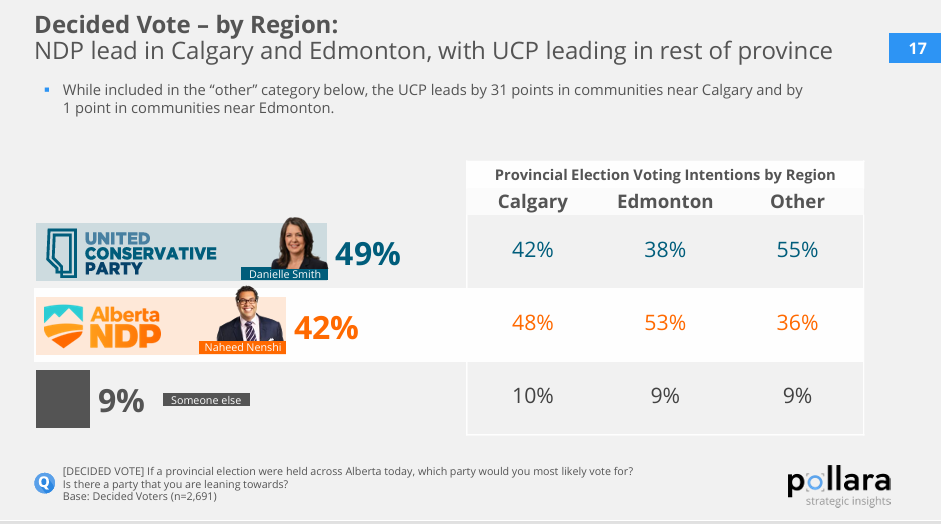
Much of the polling done over the past three years has been by national polling companies who tend to overlook Alberta’s electoral requirements. When the UCP is polling at 49 per cent support provincially, but 55 per cent in rural, it skews the numbers.
Pollara recently took some time to provide a more appropriate regional analysis based on the electoral realities in the province. They came up with the same overall support for the UCP as recent national pollsters, showing that the UCP are ahead with around 50 per cent. When they accounted for the three regions, however, the numbers don’t look so good for the UCP.
According to their research, the NDP lead in both Calgary and Edmonton. Not only that, but they’ve managed to increase their support within all three regions since 2023 (using Janet Brown’s 2023 data set because it’s the only one available; not an apples to apples comparison).
Janet Brown Opinion Polling’s most recent available provincial public polling is from 2023, just before the election.
Her amalgamation of decided and leaning data showed the UCP with 52 and the NDP with 44 (also the final results). In rural, she had 66 to 29 (final result was 65 and 30). However, both Calgary and Edmonton numbers fell short for the NDP with projected 46-49 and 57-41 where the outcome was 49.5-48 and 63-31 (NDP-UCP) in Calgary and Edmonton respectively.
As noted, it’s not a direct comparison because the two data sets and methodology were likely different, but the two that bothered to specifically differentiate between the three regional areas are showing possible movement that benefits the NDP more than the UCP. Even more importantly, is a notable difference in rural.
It becomes important as the UCP is aiming to increase their own electability by including rural polls with urban. Where one would assume that it would help the UCP more than the NDP, that may not be the case if rural support for the UCP is down.
One also has to wonder who the “other” is referring to. 9-10 per cent support for a third party is the difference between winning and losing if the races are close. While I could entertain the possibility that some of that might be related to the recent (re)introduction of the Tory party, at least in Calgary and area, I would bet Edmonton pulled Liberal and rural leaned Republican. Unless the support is dense, it wouldn’t change the fact that it remains a race between two parties.
A winning strategy usually takes more than fixing the outcome. I’m not saying it won’t work out for the UCP but what they might end up doing is taking away the opportunity for the NDP to win in Red Deer and Lethbridge (four seats) while losing support in seat rich areas.
Setting their sights on rejigging the electoral map doesn’t come from a place of strength. The UCP risks further alienating voters who aren’t willing to support it and they can’t afford to lose any support if they want to win the next election.
Admittedly, short-sighted decisions with no thought to an outcome they don’t actually want is entirely on brand for this government and so the fact that they would move forward with this plan is not a surprise.
Even if I don’t think it will work out for them.
Que sera sera.
Thanks to everyone who reads, shares, and becomes a free subscriber. Please consider becoming a paid subscriber to support my work; to those who have, your support is greatly appreciated!
I have lost all hope that there remains a scintilla of integrity or ethics in the UCP Zombie Caucus. We didn't elect them to be crooks but they are apparently willing to be crooks, silent but crooked.
Gerrymandering???? Hmmmm where have I heard that term before, Oh wait...
Meanwhile here in Quebec the CAQ's attempt at their own version of gerrymandering was just shot down by both supreme courts.
There is hope Deirdre.