

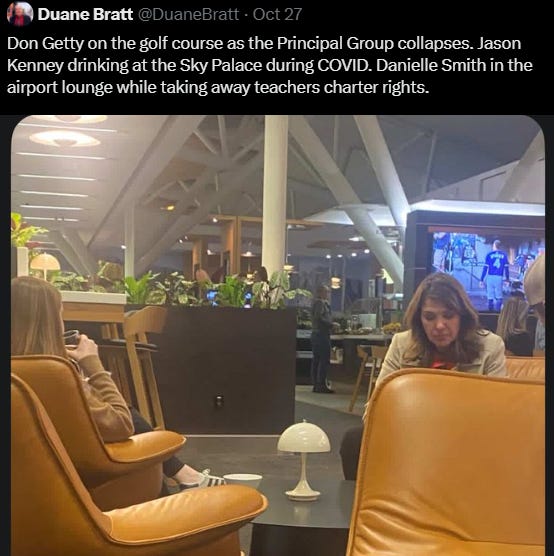
The “get out of the Charter-free card” quote belongs to Vassy Kapelos during an interview with Alberta Education Minister Demetrios Nicolaides on CTV’s Power Play on October 28, the day after the United Conservative Party waited for the clock to run out on a few of hours of opposition statements — reduced time allotted by the governing party — before legislating teachers back to work Monday night.
Minister Nicolaides is also facing a recall petition in his riding of Calgary-Bow over what the petitioner said is “a failure to support public education.” The Minister responded saying he disagreed with the recall because it was targeting government policy rather than his record as a representative. It’s a complete turn-around from his position in 2015, when he argued that recall should be “free and readily available”, “with no strings attached”. The petition requires 16,006 signatures from voters in his riding.
Alberta teachers are returning to the classrooms Wednesday after having been on strike in the province since October 6.
What makes the back-to-work legislation remarkable is that the UCP preemptively invoked the notwithstanding clause (s. 33), which allows provincial governments to write and enforce legislation overriding the rights of its citizens. The UCP’s legislation also had to note that it was overriding the rights “protected” in its own now-meaningless Alberta Bill of Rights.
In the former one-party province with a premier who has no respect for the federal institution of government, it is not surprising that she would lead her party to trample on rights “guaranteed” by the Charter of Rights and Freedoms, but throwing out their own previously touted “protections” from the Alberta Bill of Rights may remind Albertans that there is no such thing as a “God-given” or “inalienable” right that their government cannot dismiss at will. Much fanfare was made of Alberta’s Bill of “rights” back in October 2024, with the Premier claiming that “Alberta should be the freest place in Canada, and (the UCP is) committed to making that a reality.”
“Committed” is such a vague word, really.
Why the notwithstanding clause?
Often referred to as “the nuclear option” when choosing to remove rights from Canadian citizens, the notwithstanding clause was advocated for inclusion in the Canadian Charter of Rights and Freedoms by provincial premiers, including Alberta Premier Peter Lougheed. While I cannot speak to the motivations of others, as an Albertan who has been bombarded with “Ottawa is against us” rhetoric from politicians all my life, I expect The Honourable Premier’s motivations stemmed from the same. The inclusion of the clause was meant to allow provincial governments an option to protect its citizens from federal overreach. A bare ten years later, then former-Premier Lougheed attempted to clarify his position on its use, believing it should require consensus from more than the governing party before invoking, but most prefer instead the Alberta alone bluster from when he was leader.
The clause has been used more frequently in recent years. In Quebec it was used to protect majority use of French in the public service and allow inspectors search and seizures of businesses without a warrant, as well as targeting those whose religious affiliation require visible “religious symbols”, Saskatchewan used it in 2023 to ensure no child can choose to be called by another name at school without parental consent, as well as in 2017 to continue public funding for separate schools, and Ontario used it in 2021 to preempt a teacher’s strike.
It is the simplest way for a provincial government to ignore their own responsibility — at least in between elections. Quebec isn’t heading to the ballot box until late 2026, but the governing CAQ has been polling below the Parti Quebecois since at least early 2024 and as of July has sunk below the provincial Liberals. In the 2024 election in Saskatchewan, the governing Saskatchewan Party was almost entirely shut out of urban centres, holding onto only one seat in the more populous regions. Not that there can’t be other reasons for residents to decide they need a change. Ontario is an outlier with low turnout and no party or leader nipping at “Captain Canada” Doug Ford’s heels.
In Alberta, recent polling suggests that the teacher’s strike did not help the UCP government’s approval and we’ll have to wait and see whether their willingness to use the “nuclear option” when they had other options available matters to a province of “strong and free”-minded individuals.
The UCP also plans to use the notwithstanding clause to refuse care to transgender people, as per direction from the Premier’s Office, in the “freest place in Canada”.
During an exchange between Naheed Nenshi, Leader of the Official Opposition, and Minister of Finance Nate Horner, Mr. Nenshi asked whether the government could commit (though we know what that would be worth) to not using the notwithstanding clause in the future, which he did not get.
(NOTE: I also missed the qualification while covering QP on BlueSky; although it’s easier, and far more entertaining, to go through my thread rather than watching or reading the entirety of QP, if you see something that sparks your interest, do look to Hansard for the exact quote. I don’t like to repeat govt talking points, I’ll fact check, and sometimes I miss parts while looking for links or snarky GIFs — always double check in Hansard — I do).
Mr. Nenshi:
You know, Mr. Speaker, I’m happy to take the minister at his word here. He’s just told us that this was a very unique set of circumstances. It was, of course, a very unique set of circumstances created by this government and a very unique set of circumstances that led this government caucus to swing in the wind when this government refused to take on any of its other expectations. So setting aside all of that, if this is a unique situation, this should be an easy one for the government.
Will the government commit today to never again pre-emptively use the notwithstanding clause?
Mr. Horner:
Mr. Speaker, I find in this job that we need the tools that we have to have to make decisions to govern the province. This is within the Constitution. It has not been used often across this country, and I have a hard time imagining a situation where it would need to be used for public-sector collective bargaining in any other situation. That’s how unique this is with the teachers.
(Emphasis mine)
Good news for “public-sector collective bargaining,” at least until 2028, I guess.
Do as I say, not as I do
As Vassy Kapelos pointed out to the Minister Nicolaides in her interview, the UCP government generally, and the Minister specifically, had other options available.
“This is from your government’s own website; ‘there are two mechanisms, one that has been used before, one that hasn’t: Disputes Inquiry Board, which would have allowed through a Ministerial Order, you didn’t even need to be in the Legislature, a Minister to suspend the strike for at least 30 days, introduce a third party, it could be binding or not binding,” Ms. Kapelos said.
“Then there’s the possibility of the Public Emergency Tribunal, which hasn’t been used but could have been used, again, that would have avoided introducing the notwithstanding clause and forcing a contract on teachers for a number of years.”
“So, we could have had students return to class for 30 days and and be back and out on strike again,” Minister Nicolaides responded, insinuating that the government was not willing to bargain in good faith, necessitating the use of the clause.
The Minister and Premier have both made remarks indicating that discussions had been ongoing for 18 months, yet for longer still, the public has heard that class sizes (2024), class sizes and student complexities (2022), UCP funding model (2024, )as well as a lack of support staff (2023) were all issues the UCP promised to fix.
Yet, it wasn’t until the day after the UCP removed the right to strike from teachers that the Minister of Education claimed to be looking for answers.
Meanwhile, the Premier trotted out her doe-eyed deniability saying she just didn’t understand what was going on with classrooms and teachers and, you know, it just didn’t make sense that there’s not enough teachers but her government doesn’t like know; they just, like, you know, have questions, and golly gee whiz, like, how would people even know where to find this stuff?
Eighteen months they’ve been having these discussions, they said. Eighteen months and they didn’t have any information on issues that teachers, and the Alberta Teacher’s Association, have been talking about for three years.
Sounds like the real problem is that the UCP government refused to listen and decided teachers shouldn’t be allowed the right to demand they start listening.
Thanks to everyone who reads, shares, and becomes a free subscriber. Please consider becoming a paid subscriber to support my work; to those who have, your support is greatly appreciated!
This is a bit beyond the content of this post, but shouldn’t the Alberta Labour Federation call for a general strike? I know it sounds extreme — we’re not France — but now the provincial government has employed the “nuclear option”, what is left but a response equally extreme?
More than anything, it is the cavalier application of the Notwithstanding Clause that must give every Albertan pause, unionized or no. In this particular case, the government has declared, openly and unapologetically, that they don’t care what anyone says.
Very proud of a number of students here in High River protesting in support of their teachers 100 yards away from Mrs Moretta’s (smith) failing train car restaurant. They were polite, informed and represented themselves very well.
Too bad Mrs Moretta couldn’t be A) in the country, B) in the province or C) at home defending her cowardly decision
The kids, Mrs Moretta, were speaking; and like everything else in your world if that voice didn’t come from inside your own head you couldn’t hear it.